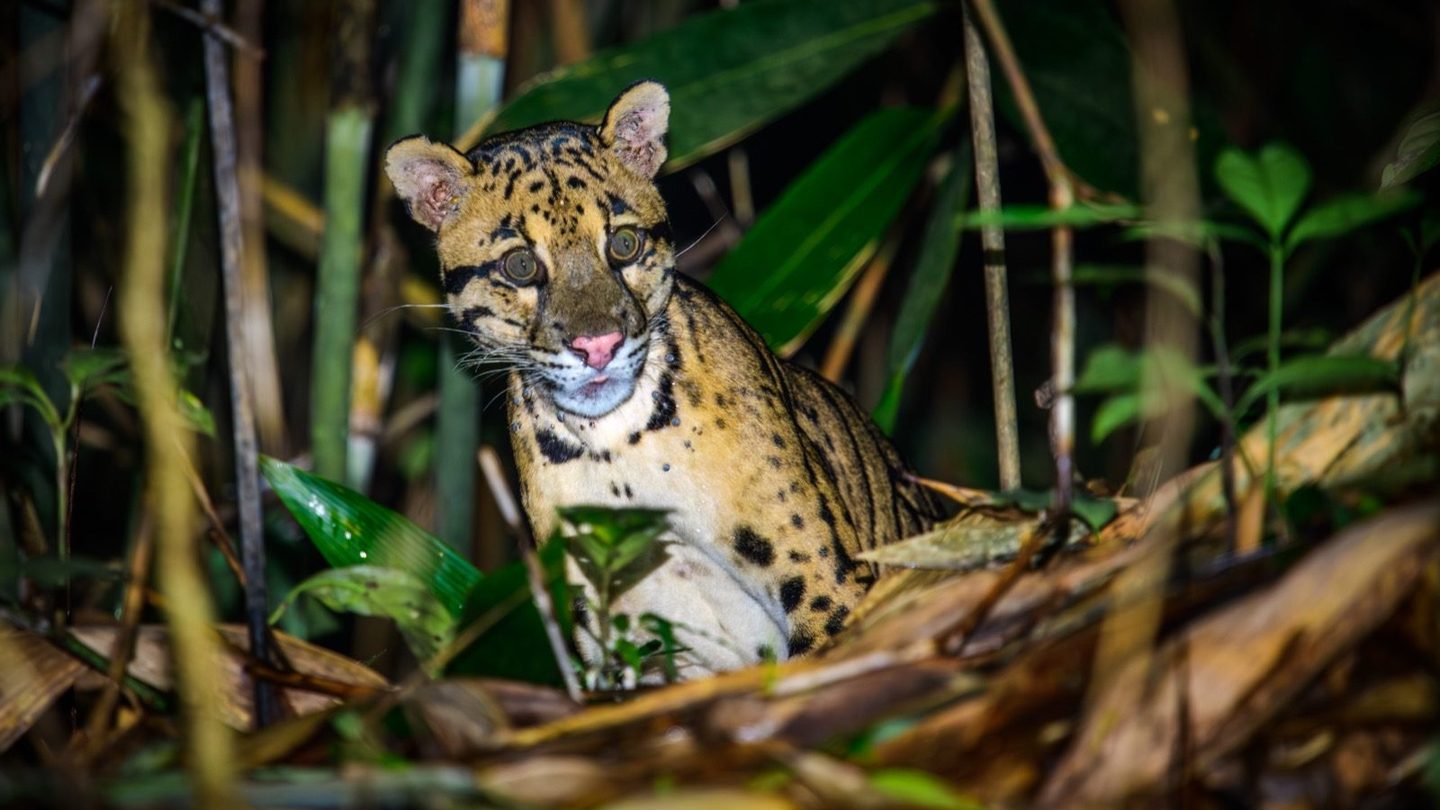

One animal, two species since 2006
Edward Griffith's 1821 description named a single wide-ranging species, Neofelis nebulosa, found from the foothills of the Himalayas through mainland Southeast Asia and south into the Indonesian islands of Sumatra and Borneo, conventionally split into as many as four geographic subspecies depending on the authority consulted. That single-species picture held for close to two centuries, even as field reports kept noting how different the mainland and island cats looked, until two research teams working independently, with two different kinds of evidence, published their conclusions in the same December 5, 2006 issue of Current Biology.
Valerie Buckley-Beason, Warren Johnson, and colleagues at the National Cancer Institute's Laboratory of Genomic Diversity sequenced mitochondrial DNA, nuclear DNA, and 51 microsatellite loci across 109 clouded leopards of known geographic origin. They found 36 fixed mitochondrial and nuclear nucleotide differences and 20 microsatellite loci with completely non-overlapping allele ranges separating the mainland population from the Bornean individuals in their sample, a degree of genetic separation the paper states is equal to or greater than what distinguishes the lion, tiger, jaguar, leopard, and snow leopard from one another, the five species making up genus Panthera.
Andrew Kitchener, Mark Beaumont, and David Richardson at the National Museums of Scotland reached the same conclusion from a completely different direction, running a morphometric analysis of pelage patterns across 57 clouded leopard specimens sampled throughout the species' range. They found the cats sorted into two distinct groups differing primarily in the size of their cloud markings, mainland animals carrying larger clouds with fewer internal spots and island animals carrying smaller, more heavily spotted ones, and cited the concurrent genetic paper as independent support for the same split. Together, the two papers produced the names still used today: Neofelis nebulosa for the mainland lineage, and Neofelis diardi, the Sunda clouded leopard, for the population on Sumatra and Borneo. A 2011 study led by Andreas Wilting pushed the resolution further, finding enough genetic and morphological separation between the Bornean and Sumatran island populations to recognize them as two distinct subspecies of N. diardi rather than one uniform island population.
The split is exactly the kind of revision a broader genetic assessment of the cat family has kept producing since, each new DNA dataset drawing boundaries that pelage and skeletal measurements alone hadn't settled. It also feeds a real, recurring point of confusion: a Quora thread asks directly what separates a clouded leopard from "a regular panthera family cat," and the accurate answer is that Neofelis was never part of the five-species Panthera lineage at all, before or after 2006. The split only changed how many clouded leopard species there are, not which genus either one belongs to.
A skull that borrows from an extinct sabertooth’s playbook
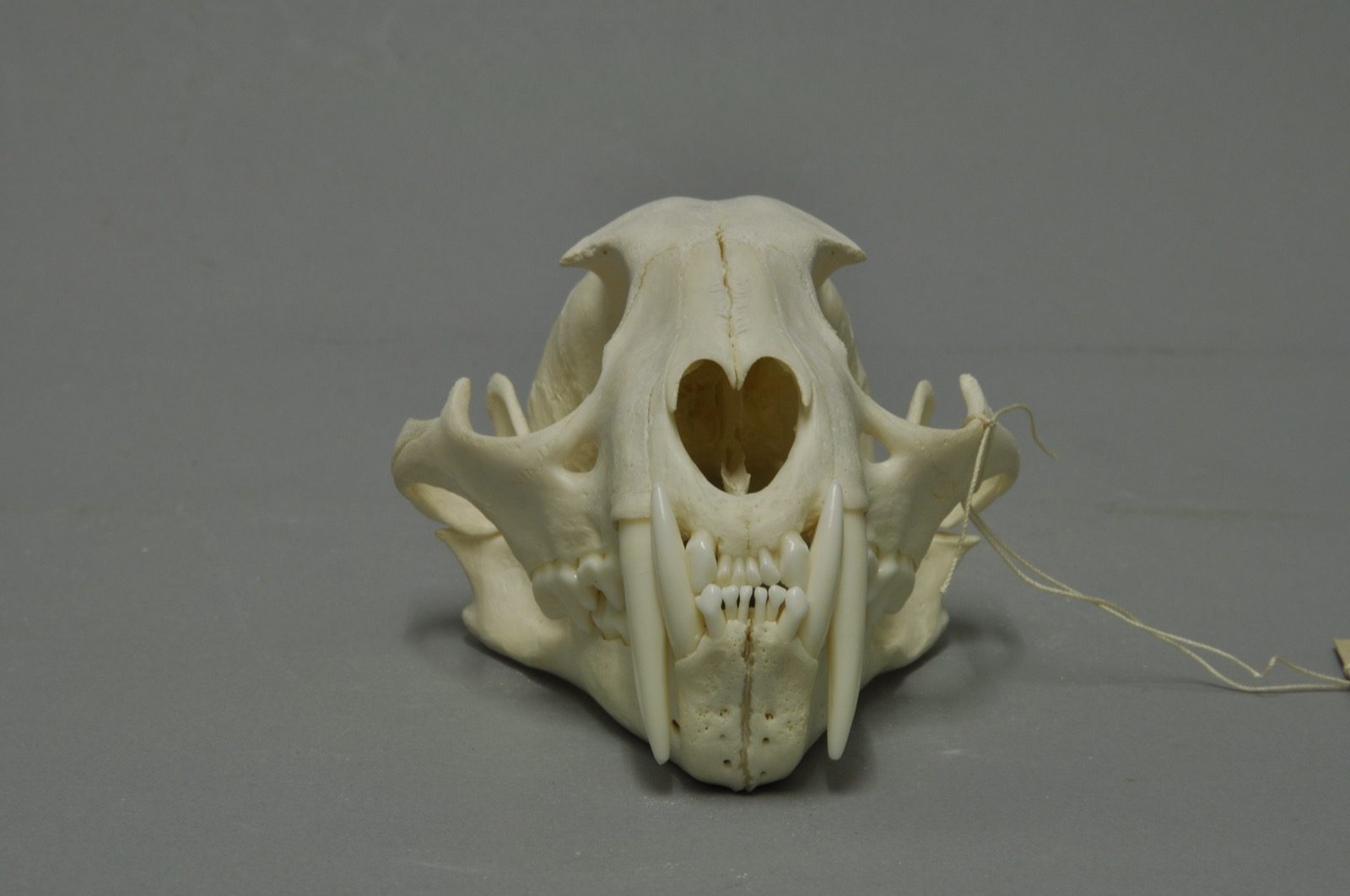
The clouded leopard's best-known trait isn't its coat. A 2017 literature review in the International Journal of Avian & Wildlife Biology by Po-Jen Chiang and Maximilian Allen describes the species as carrying "notably long canines relative to skull size," and it's that relative measurement, not raw length, that sets it apart: no other living cat's upper canines reach as far down the jaw relative to the length of its own skull.
A 2006 study in the Journal of Morphology by Per Christiansen found the resemblance runs deeper than tooth length alone. Examining the clouded leopard's skull, Christiansen identified a set of features, chiefly adaptations that let the jaw open unusually wide, that had previously been considered exclusive to the extinct sabertoothed felids of subfamily Machairodontinae and were assumed absent in every living cat. Finding them in a living species meant the clouded leopard's skull had converged on a primitive sabertooth blueprint by an entirely separate evolutionary route, arriving at a similar wide-gape solution to the same basic problem: clearing a long canine around prey without catching it on the lower jaw.
That convergence points toward the early, less specialized end of the sabertooth lineage, not toward Smilodon, the heavily built Ice Age predator most people picture when they hear "saber-tooth tiger." Smilodon's own jaw could reportedly open past 110 degrees, backed by forelimbs strong enough to pin prey in place before a single precise bite, a far more specialized setup than a midsized forest hunter needs for a diet of deer, wild pigs, and primates. Christiansen's finding cuts the other way: if a living, midsized cat can independently grow several of the same gape-related features credited with making sabertooth skulls distinctive, that raises a real question about how much those features alone can tell paleontologists about how any given extinct sabertooth actually hunted, Smilodon included.
None of this makes the clouded leopard a relative of Smilodon's lineage. A 2023 whole-genome study already established that its genus, Neofelis, split from Panthera, the genus containing the lion and tiger, only around 6.19 million years ago, a recent divergence by cat-family standards and one that runs through a branch of the family tree Machairodontinae never touched. The resemblance to an extinct sabertooth and the genetic closeness to Panthera are two separate facts about the same skull, produced by two different kinds of evidence, and neither one explains the other.

What tracking only seven wild clouded leopards has shown
Much of what gets repeated about clouded leopard behavior rests on a strikingly thin evidence base. Chiang and Allen's 2017 review found that, across the published literature up to that point, only seven wild clouded leopards had ever been fitted with a radio collar and tracked, yielding home range estimates of 33.6 to 39.7 square kilometers for females and 35.5 to 43.5 square kilometers for males. Population density estimates across different survey sites ranged from 0.58 to 6.53 individuals per 100 square kilometers, and the review states plainly that there has never been a targeted study of clouded leopard diet, only scattered observations showing they take deer, wild pigs, primates, and smaller prey depending on what a given forest offers.
That thin evidence base has let a widely repeated claim go uncorrected for years. Most popular accounts describe the clouded leopard as simply nocturnal, but the radio-telemetry data Chiang and Allen reviewed tell a more specific story: tracked cats showed arrhythmic activity, with the highest levels recorded in the morning, followed by a second peak during evening crepuscular hours, rather than activity spread evenly across the night.
The clearest behavioral signature researchers do agree on is built around trees rather than the ground. Citing a 1968 ethological study by Helmut Hemmer, the review describes clouded leopards in captivity repeatedly observed descending tree trunks headfirst, moving along the underside of horizontal branches with their backs to the ground, and hanging from branches by their hind feet alone, movements the review ties to short, powerful legs, oversized paws, and a long tail that together lower the animal's center of gravity in the canopy. That headfirst descent isn't unique to clouded leopards worldwide. A 2017 anatomical study found the margay is the only arboreal Neotropical cat confirmed able to climb down a tree trunk headfirst, made possible by a tarsal joint that rotates close to 180 degrees. Read against Hemmer's decades-older observations of clouded leopards doing much the same thing on the opposite side of the planet, it looks like two unrelated cat lineages separately arriving at the same solution for hunting from above rather than below.
Vulnerable across its range, confirmed extinct in one country
Both current species carry the same formal conservation status. The IUCN Red List classifies the mainland clouded leopard, Neofelis nebulosa, as Vulnerable, and lists the Sunda clouded leopard, Neofelis diardi, as Vulnerable as well, citing population declines driven by deforestation, snaring set for other species that catches clouded leopards incidentally, and hunting for skins and bones in parts of its range.
One population never survived long enough for that global assessment to matter locally. The Formosan clouded leopard, a subspecies once endemic to Taiwan, was the subject of a 2015 study in Oryx by Po-Jen Chiang, Kurtis Pei, and seven colleagues, who ran a nationwide camera-trap survey from 1997 to 2012 covering 1,249 sites from sea level up to 3,796 meters in elevation, accumulating 113,636 camera-trap days on that survey alone and 128,394 once combined with other studies' trap data. Across fifteen years of fieldwork and well over 100,000 camera-trap days, the result was zero photographs of a clouded leopard. Taiwan's government had already declared the subspecies extinct in 2013, while the survey that produced the most systematic evidence for that conclusion was still being finalized for publication.
The declaration hasn't entirely settled the question in practice. Rangers in Taitung County have reported unconfirmed sightings since, including one account from February 2019 describing a cat hunting goats on a cliffside, and by 2026 researchers were modeling Taiwan's habitat suitability for a potential reintroduction using clouded leopards drawn from the surviving mainland population. None of that amounts to evidence the original Formosan population survived. It means Taiwan is treating the 2013 declaration as the starting point for bringing the species back, not as a question still open about whether it ever left.