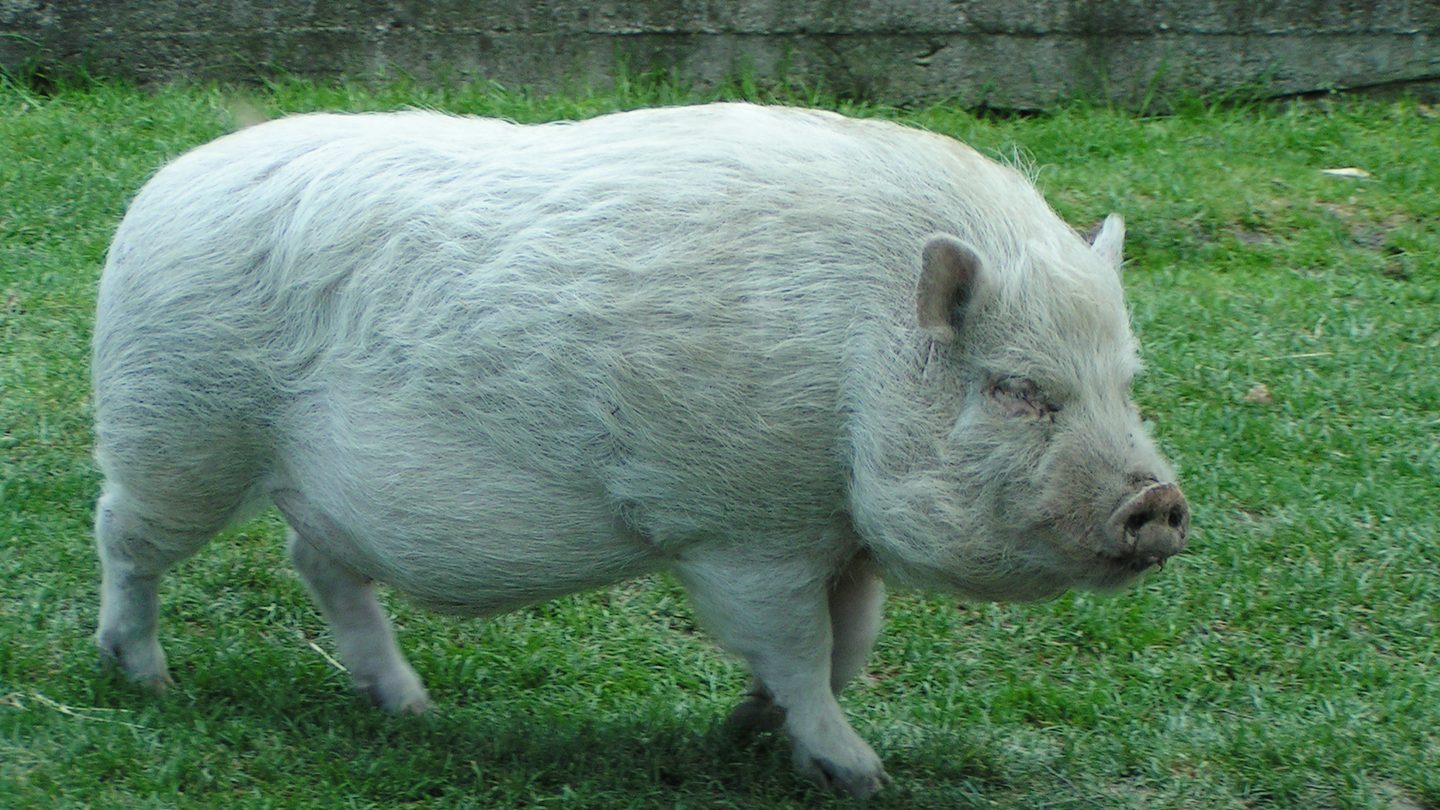

The study that puts them side by side
Most of what gets said about pig versus dog intelligence draws on separate studies of each species, run by separate labs, using different tasks, then stitched together after the fact. A 2019 paper in the journal Animal Cognition, from the Department of Ethology at Eötvös Loránd University in Budapest, did something more direct: it ran two linked studies on family-raised, human-socialized pigs and dogs. The first involved ten miniature pigs and ten dogs from eight breeds; the second, weeks later, reused most of those same pigs alongside a fresh group of nine dogs.
The first test measured how each animal behaved around a researcher who had just stopped handing out food. With no food present, pigs and dogs oriented toward and touched the researcher's body for about the same amount of time. Once food entered the picture, both species intensified that behavior, but a difference showed up in where they looked: dogs turned to the researcher's face more often than pigs did, and pigs mostly did it only when food was involved. Reading a face for information, rather than just tracking a food source, came more readily to the dogs.
The second test was more pointed, literally. Researchers held out an arm toward one of two containers, a gesture with no prior training attached, then let the animal choose. One of the nine pigs had to be dropped from the analysis; she wouldn't tolerate being held still long enough to pay attention to the gesture. Of the eight pigs actually tested, every single one settled into a habit of picking whichever side it had chosen before, ignoring the gesture entirely, while the dogs spontaneously used the sustained version of that gesture to find the food-baited container on their first exposure. Individual socialization had put pigs and dogs on equal footing for basic social approach behavior. It hadn't put them on equal footing for reading a hand.
Where pigs outperform the stereotype
None of that makes pigs the slower animal overall. In a 2021 study published in Frontiers in Psychology, Purdue animal scientist Candace Croney trained four pigs, two Yorkshires named Hamlet and Omelet and two Panepinto micro pigs named Ebony and Ivory, to operate a joystick that moved a cursor toward on-screen targets. The task demanded both a grasp of the setup (moving a stick controls a cursor on a separate screen) and enough motor control to actually land it. On the hardest version of the task, a single-walled target, Ivory hit it correctly 76% of the time, far above the 25% expected by chance; the two Yorkshires cleared chance on that same setting too, just at a lower 42-48% rate. Flip to the easier three-walled version and the ranking reversed: both micro pigs cleared chance there, but the two Yorkshires didn't quite reach statistical significance. Croney told reporters afterward that the results pointed to more behavioral flexibility in pigs than researchers had generally assumed.
A separate line of research tested something almost nobody expects a farm animal to manage: using a mirror. In a 2009 study published in Animal Behaviour, researchers gave young pigs five hours of exposure to a mirror, then showed them a food bowl that was visible only in the mirror's reflection, hidden from direct view behind a solid barrier. Seven of eight pigs found the bowl in a mean of 23 seconds by walking away from the mirror and around the barrier, rather than searching behind the mirror itself, the giveaway that they were using the reflection as information rather than treating it as another pig.
That finding hasn't held up cleanly on a second attempt. A 2014 study in Applied Animal Behaviour Science tried to replicate it with two fresh groups of eleven piglets each, following the original method as closely as the researchers could manage. Only two piglets in the first group solved the task, and after the researchers adjusted the setup for a second group, just one mirror-experienced piglet did. The original result wasn't fabricated, but it also wasn't as reliable as a single well-covered study made it look, and that gap between a striking first finding and a shakier replication is itself a fair summary of how contested pig cognition research still is.
Why dogs read us better, and what that doesn't prove
The pointing-gesture gap in the pig-dog study lines up with a much larger body of research on dogs specifically. A 2012 study in PLOS ONE tested 32 dogs against 20 chimpanzees on the same kind of task, a person pointing at one of two containers to indicate where food was hidden. The dogs succeeded; the chimpanzees, humanity's closest living relatives and demonstrably capable of sophisticated tool use and social reasoning in other contexts, largely did not. The leading explanation, developed by researchers including Brian Hare, is that thousands of years of selection for cooperating with humans built gesture-reading into dogs at a level that raw brainpower alone doesn't predict; wolves raised alongside people don't show the same spontaneous skill, so it isn't simply exposure to humans either.
That skill is specific, not a stand-in for general intelligence, and dog cognition research keeps turning up cases that make the same point from the opposite direction. Border collie Chaser, trained by researcher John Pilley over three years of daily sessions, learned the individual names of 1,022 distinct toys and could fetch the right one on request, a feat documented in a 2011 paper in Behavioural Processes. That's an exceptional dog after years of dedicated training, not a baseline for the species, but it shows dogs have room for skills well beyond gesture-reading when someone puts in the work to develop them. The same Budapest ethology department behind the pig-dog comparison has also traced why dogs still howl back to inherited wolf signaling that some breeds retain more strongly than others, a reminder that a lot of dog behavior research keeps landing on the same idea: what a dog does with people is a mix of inherited wiring and what it was specifically bred, or trained, to do.
So which one is actually smarter?
"Smarter" is doing a lot of unexamined work in that question. Comparative cognition researchers generally avoid a single intelligence score across species for the same reason nobody ranks a shark against an eagle on how well it swims: the tasks that matter to one species' evolutionary history aren't the tasks that mattered to another's. Dogs were domesticated over roughly 15,000 years specifically for jobs that required cooperating with and reading humans, herding, guarding, hunting alongside people, so selection pressure built a gesture-reading and face-attending skill set most other animals, including our closest primate relatives, don't spontaneously have. Pigs were domesticated mainly for meat production, a process that didn't select for interpreting human body language, but it left largely intact the general problem-solving and spatial cognition their wild boar ancestors needed to forage, remember terrain, and navigate.
Put the specific, tested results side by side and the split holds up:
| Task | Dogs | Pigs |
|---|---|---|
| Spontaneously follow a human pointing gesture to find food | Succeeded on first exposure | All 8 tested developed a side habit instead |
| Operate a joystick to hit an on-screen target | Not tested in comparable studies | Best performer (Ivory): 76% correct on the hardest setting (chance = 25%) |
| Use a mirror's reflection to find hidden food | Not directly compared | 7 of 8 succeeded in one study; a later replication mostly failed |
| Read a human face for information | Looked at the face more often, even without food present | Looked at the face mainly when food was involved |
None of that adds up to a scoreboard. It's closer to the difference between asking who's better at chess and who's better at rock climbing: pigs and dogs are answering questions their own domestication history put in front of them, and the pig-dog comparison in this article is one of the few times anyone has actually asked both the same question at the same time.