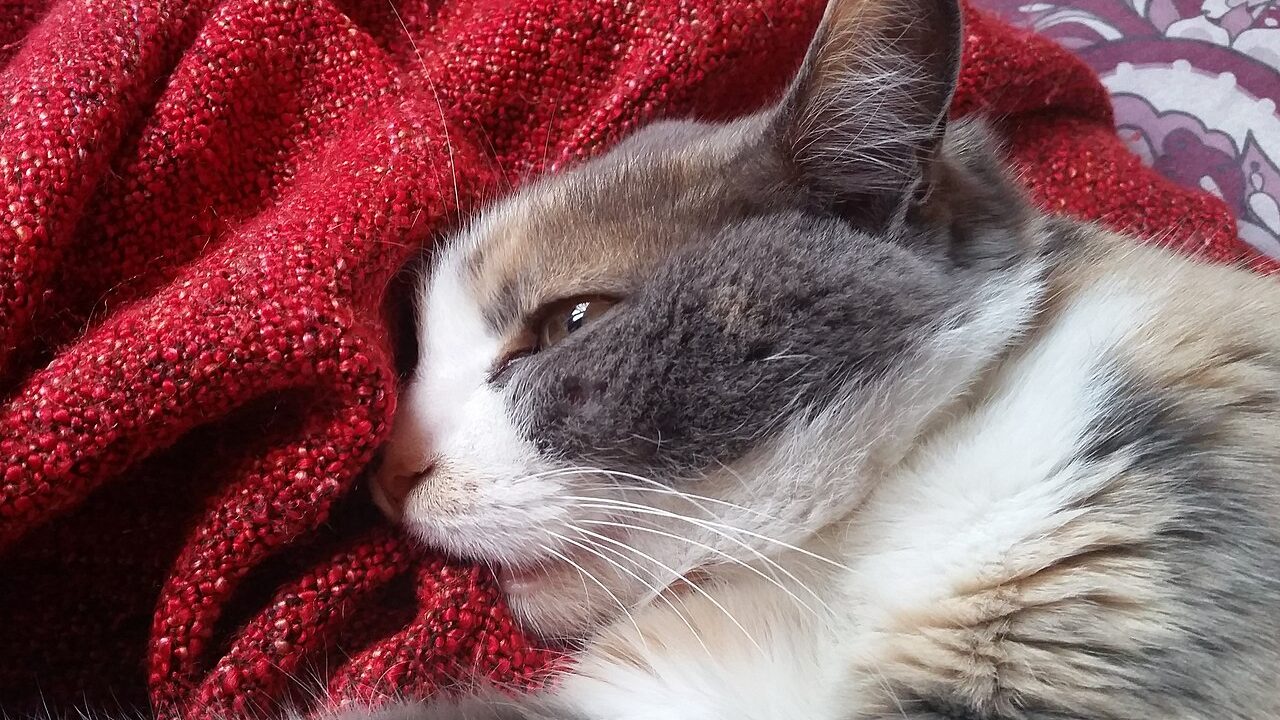

What a cat is doing when it makes biscuits
Kneading is a rhythmic paw movement. The cat presses one front paw down into a soft surface, spreads its toes so the claws show, then draws the claws in as it lifts the paw and repeats with the other one. Wikipedia's entry on the behaviour puts the interval at one to two seconds per paw, and notes that a cat will sit happily on a hard floor but will only knead something soft or pliant (some cats reflexively "march" on hard surfaces instead). The nickname comes from the resemblance to a baker working dough, and "making biscuits" is the same joke.
Purring often comes along with it, which is why kneading gets read as a happiness signal. Some cats also drool while doing it. Kansas State veterinarian Susan Nelson told Scientific American that the drooling ones are "the really happy guys." That is a vet's impression rather than a measured result, and it fits the general pattern of this topic. Most of what gets said about kneading is informed observation from people who spend their days with cats, and very little of it is experiment.
The four explanations, and how well each one is supported
Four explanations come up again and again, and the sources treat them differently. A fifth, plain physical comfort, gets a brief mention too: Fanucchi notes that kneading stretches a cat's muscles, and Wikipedia says some experts think it feels good the way stretching does. Nursing is the best supported for kittens. For adult cats none of the four has been tested on its own, so the table below reports what each source actually claims and how firmly.
| Explanation | Who proposes it | How firmly it is stated (our reading of the sources) |
|---|---|---|
| A leftover from nursing | Leticia Fanucchi (Oklahoma State), Susan Hazel and Julia Henning (University of Adelaide) | Firm for kittens: they knead the mother to stimulate milk flow, and the behaviour does not have to be learned. For adult cats, framed as a carried-over habit |
| Scent marking | Lauren Finka (Cats Protection), Leticia Fanucchi (Oklahoma State) | Cats have scent glands in the paw pads. Finka says it "may be" why they knead us. Stated as possible, not measured |
| Nest making | Wikipedia, in its list of hypotheses | One of several hypotheses. Wikipedia says nest-making with claws out differs in body language and intent from contented kneading |
| Affiliation and comfort | Kristyn Vitale (Unity Environmental University), Hazel and Henning | A widely offered reading of adult kneading on a person. Experts describe it as the cat treating you as a preferred, safe individual |
The nursing story is the one most people have heard. A kitten pushes on the mother's mammary glands to get milk flowing. Fanucchi adds that the kitten's kneading may release oxytocin in the mother, and Hazel and Henning note that the paw pads pass a scent message at the same time. The step from there to an adult cat kneading a human is the untested part. Both Scientific American and BBC Science Focus reach it through neoteny, the way domestic animals keep juvenile traits into adulthood, and neither presents it as proven.
Nest making sits apart from the other three. Wikipedia describes round, cat-sized hollows trodden into long grass in gardens where cats live, and cats working cardboard boxes the same way with claws out. It also says this looks different from happy kneading. So if your cat digs into a cushion with claws fully extended and a serious expression, that may be a different job from the slow, purring version.
Why on you, and why some cats never do it
Lauren Finka gives the clearest account of why the behaviour lands on people. She told BBC Science Focus that free-living cats that are not socialised to humans do not tend to keep up behaviours like kneading, meowing and purring once they leave the nest. Those habits belong to life with the mother and littermates. Pet cats live among social partners all their lives, so they keep them, and humans unknowingly encourage the cats to keep them in their repertoire.
Encouragement is part of the mechanism. Hazel and Henning point out that owners often reward kneading with attention, which makes it likelier next time. Vitale's reading is that behaviours once aimed at the mother may now be aimed at the preferred person, and that kneading on you can be a bonding behaviour in its own right. Finka adds a hedge. Cats with early positive experiences of humans may be more likely to do it, but individual variation is large.
That variation cuts both ways. Vitale told Scientific American that a cat that never kneads can still have a strong bond, and lists purring, rubbing and simply sitting next to you as other signs. Finka makes the same point to BBC Science Focus. Some cats also want different things while kneading. Vitale describes cats that want petting, cats that want to be talked to, and cats that want to knead and be left alone. So the cat in front of you is a better guide than any general rule.
Readers often ask about timing, such as kneading just before lying down, in the morning, or while you sleep. None of the sources above examines when in the day cats knead. One inference is available and it should be labelled as one. If nest treading is part of the story, kneading before settling to rest would fit it, but no source tests that. Treat the pattern as an observation about your cat, not a finding.
What the behaviour can and cannot tell you
Kneading is usually good news. Hazel and Henning say it most likely indicates a comfortable cat. The same source lists the cases where it does not. If kneading, and especially sucking on fabric, happens very often, goes on for a long time, looks compulsive, or starts to damage the cat's paws, legs or mouth, it may signal stress or pain and warrants a vet visit. They note that the compulsive version is a particular problem in Siamese and Birman cats. Scientific American adds that injured cats sometimes knead and purr, which experts think may be an attempt to self-soothe.
That second point matters because it mirrors what is known about purring. The purring guide on this site covers how the same sound shows up in contented cats, in nursing kittens, and in cats that are frightened or hurt. Kneading accompanied by a purr therefore does not settle the question of mood. The rest of the cat's posture and the situation do that work.
| What you see | Most cautious reading from the sources | Source |
|---|---|---|
| Slow paw pushes on a lap or blanket, relaxed body, often purring | A comfortable cat. On a person, likely affiliation | Hazel and Henning; Vitale via Scientific American |
| Claws fully out, digging into cushions or boxes as if making a hollow | Possibly nest making, which Wikipedia says has different body language and intent | Wikipedia |
| Kneading and sucking fabric, frequent, long, hard to interrupt | Possible stress or pain. Vet check, especially in Siamese or Birman cats | Hazel and Henning |
| An injured or unwell cat kneading and purring | May be self-soothing, less common | Vitale via Scientific American |
| Your cat never kneads | Not a sign of a weak bond | Vitale via Scientific American; Finka via BBC Science Focus |
Wikipedia adds one more association. Kittens taken from their mothers before they are fully weaned may develop the habit of kneading, and sometimes suckling, a person they have adopted as a maternal figure. It describes this as something that can happen, not as the cause of kneading in cats generally.
If the claws hurt: what the experts recommend
Both Scientific American and The Conversation advise against punishing the behaviour, since it is tied to comfort and bonding. Nelson says to avoid discouraging it too much because it is a sign of affection. The practical fixes in these sources are small. Put a thick blanket over your lap. Keep the claws trimmed, and do not declaw, which Scientific American calls harmful. Hazel and Henning also describe a training approach. Reward the version where the claws stay in with attention or a food treat, and pair it with a short cue such as "pads!" so the cat learns to keep the claws sheathed on request.
It is a different problem from the cat that has suddenly started kneading a great deal more than before. The sources give no threshold for how much is too much, so a change in your own cat's habits, particularly with sucking or sore paws, is the practical signal to raise it with a vet. The guide to why cats hate water makes a parallel point about a different habit, since how far that stereotype holds depends on the individual cat and the conditions.