
The short answer
A purr is a low, steady hum a cat produces on both the in-breath and the out-breath, which is what makes it sound continuous, unlike the on-off pulses of a meow or a bark. Across the handful of studies that have measured it, the frequency lands somewhere between 25 and 150 Hz, with individual cats settling into a fairly consistent personal range. It isn't a single-purpose signal: cats purr while draped across a lap being petted, but they also purr while nursing as kittens only a couple of days old, while begging at the food bowl, and while sitting frightened or in pain at the vet's office. The common thread isn't happiness specifically, it's closer to a general-purpose vocal tool a cat reaches for across a wide range of emotional states, one that most of the roughly 40 species making up the wider cat family share in some form, even if only the domestic-sized ones can keep it running nonstop.
The textbook explanation for how the sound gets made has stood for decades, but a 2023 laboratory study cracked it open in a way that's still being absorbed by the veterinary and biology sources most people read on the subject: it turns out a cat larynx can produce the purr's characteristic vibration with no nerve signal reaching it whatsoever.
How the sound is actually made
The long-standing model treats purring as an active, brain-driven process. A repetitive signal from a neural oscillator reaches the intrinsic muscles of the larynx, the small muscles that open and close the vocal folds, and drives them to twitch at 20 to 30 cycles per second. Each twitch briefly interrupts the airflow passing through the glottis, and it's that rapid series of interruptions, happening on inhale and exhale alike, that produces the buzzing hum. Because the twitching is supposedly muscular and requires a live nerve supply, the assumption built into decades of textbooks was that purring simply could not happen in tissue disconnected from the brain.
Christian Herbst and a team spanning the University of Vienna, the Vienna University of Veterinary Medicine, and Palacký University in Czechia tested that assumption directly, publishing their results in Current Biology in November 2023. They removed the larynges from eight domestic cats and pushed air through them in a lab rig with no nerve connected and no muscle contracting, the same basic setup used to study how most other mammals, including humans, produce voice through pure airflow and tissue vibration. All eight excised larynges self-oscillated at 25 to 30 Hz, squarely in typical purring range, with no neural or muscular input required. Dissecting the tissue afterward turned up the likely reason: cat vocal folds contain pads of connective tissue, up to about 4 millimeters thick, that add enough extra mass to let the folds flap at an unusually low frequency all on their own.
That doesn't necessarily mean the old model is wrong so much as incomplete. Herbst's team is careful to say their result doesn't fully rule out a role for active muscle contraction, since a live cat presumably still needs some way to switch purring on and off at will, something an excised larynx obviously cannot do. What the study does establish is that the passive vibration alone, the same basic physics behind a meow or a human voice, is sufficient to generate the sound, which means cat purring may work more like ordinary mammalian vocalization than the special, exclusively neural mechanism most sources still describe.
It isn't just a happiness signal
One of the more counterintuitive findings on cat purring comes from Karen McComb's team at the University of Sussex, published in Current Biology in 2009. They noticed that the purrs cats produce specifically to solicit food from their owners sound subtly different from an ordinary contented purr, and acoustic analysis confirmed it: solicitation purrs carry an extra, higher-pitched voiced component layered on top of the usual low hum, closer in frequency to a human infant's cry. When McComb's team played recordings to human listeners, including people with no history of owning cats, the solicitation purrs were rated as noticeably more urgent and less pleasant than ordinary purrs recorded from the same cats. Digitally stripping out just the embedded cry-like component brought the perceived urgency back down. The implication is that cats may be exploiting a sensitivity to infant-cry acoustics that evolved in humans for an entirely different reason, using it to make a request harder to ignore.
Purring during pain, fear, or serious illness runs the same pattern from a different angle. Veterinarians routinely report cats purring while being examined for injuries, during labor, and in the hours before death, and a Quora thread on exactly this question, whether cats stop purring as they're dying, draws real, ongoing curiosity from pet owners encountering it firsthand. The leading interpretation treats this as a self-soothing behavior, roughly analogous to a person humming under stress, not a sign of contentment. Von Muggenthaler's 2001 presentation went further, framing purring itself as a possible low-energy mechanism an injured or immobile cat could use to support its own recovery, though as the next section covers, that specific extension of the idea rests on thinner evidence than the self-soothing interpretation does.
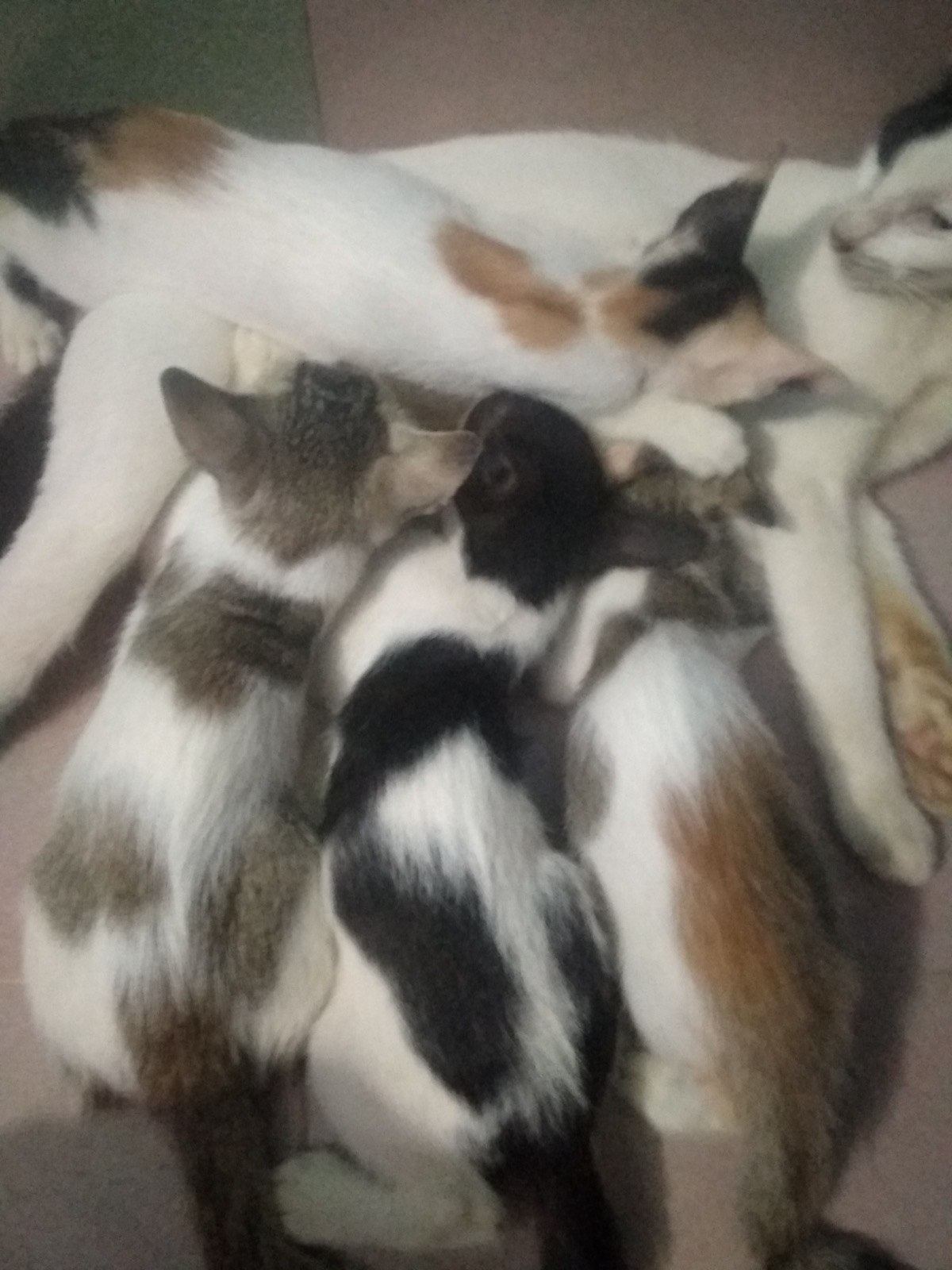
Purring starts remarkably early in a kitten's life, commonly reported as within the first two days, well before its eyes open at around a week to ten days and before it can walk or meow with any real vocabulary. At that stage it functions less as sound and more as touch: a newborn kitten is blind and its ear canals are still sealed, so the vibration is likely felt through direct contact with its mother more than heard aloud, working as a simple, low-tech "I'm here and I'm fine" signal during nursing. Nursing kittens also push against their mother with their front paws, the movement that adult cats later reproduce on blankets and laps, and why cats knead people turns out to be far less studied than the purr itself.
_her_4_kittens.jpg)
Why housecats can do this all day and lions can't
A domestic cat can purr for as long as it stays relaxed because of a specific piece of anatomy: its hyoid apparatus, the bone-and-cartilage structure that suspends the larynx from the skull, is fully ossified into solid bone. That rigid scaffolding lets the vocal folds vibrate in the fast, tightly controlled way a continuous purr requires. Gerald Weissengruber and colleagues dissected the hyoid apparatus and pharynx of the lion, tiger, jaguar, cheetah, and domestic cat and published the comparison in the Journal of Anatomy in 2002, finding that in the lion, tiger, and jaguar, the equivalent joint, called the epihyoideum, is an elastic ligament, not bone, while the cheetah's is bony, just like the domestic cat's. That flexible ligament is what lets the throat stretch out during a roar, but the same looseness makes the fast, steady vibration of a nonstop purr essentially impossible.
An earlier dissection study, published by M.H. Hast in the same journal in 1989 after examining the larynges of 14 cat species, found that the vocal folds built for high-energy roaring show up specifically in genus Panthera, with one exception: the snow leopard, a Panthera species that carries the group's general build but doesn't roar the way its closest relatives do. The pattern that emerges across both studies lines up with a broader split covered in what actually separates a "big cat" from every other cat in the family: the roar-versus-purr divide tracks anatomy far more closely than it tracks size or the popular label most people reach for. Jump height follows the same kind of size-scaling logic: a domestic cat can leap several times its body length in a single standing jump, a proportional feat far beyond what a much heavier big cat ever needs to manage.
The 'healing purr' claim, and why it's overstated
The idea that a cat's purr can promote its own healing traces back to the same 2001 work that established the 25-to-150 Hz frequency range. Elizabeth von Muggenthaler recorded 44 individual felids, including cheetahs, servals, ocelots, pumas, and domestic cats, and found every one of them produced strong frequencies in that band, with domestic cats, servals, ocelots, and pumas specifically centering on 25 and 50 Hz. She presented the work, titled "The felid purr: A healing mechanism?", at a meeting of the Acoustical Society of America, and it appeared in the society's journal as a conference abstract, not a standalone peer-reviewed research paper.
That distinction matters more than it sounds like it should. A conference abstract summarizes preliminary work presented at a meeting; it hasn't been through the same review process as a full paper, and this particular one doesn't appear to have ever been expanded into one. The underlying observation, that purring clusters in a low-frequency band, is real and has been picked up by other researchers since. What isn't established is the causal leap: no controlled study has shown that a cat's own purring measurably speeds its own bone or tissue repair. The frequency band does overlap with ranges used in legitimate human orthopedic treatment, low-frequency vibration and ultrasound devices in the 20-to-50 Hz range have real clinical literature behind them for fracture healing, but a coincidence in frequency between a cat noise and a medical device isn't evidence that the noise itself is doing the healing. Treat "purring literally heals bones" as a hypothesis worth a question mark, exactly the punctuation von Muggenthaler herself put in the title, not a settled finding. Cat behavior is full of these two-sided answers, the same territory covered in why most cats avoid water, and the specific breeds that don't: a real, physiology-based explanation exists, and it still comes with exceptions that don't fit the general rule.