
What actually defines a gait
A gait is defined by two things anyone can count on a slow-motion video: how many beats occur in one full stride, meaning how many separate times a hoof strikes the ground before the pattern repeats, and which leg moves in what order. A four-beat gait plants each hoof down on its own. A two-beat gait lands hooves in matched pairs. Montana State University's equine extension program lists four gaits that show up naturally in almost every breed without any training at all: the walk, the trot, the canter, and the gallop.
A smaller group of acquired or ambling gaits, among them the rack, the running walk, the fox trot, and the tölt, appears only in specific breeds, and a horse's build, shoulder angle, back length, leg proportions, decides how easily a given gait comes, or whether it's possible at all. None of this is decorative terminology. A horse's beat pattern and footfall sequence change its balance, its top speed, and how comfortable it is to ride, which is exactly why breeders and riders have argued about gait mechanics for centuries, long before anyone had a way to actually check who was right. Limb proportions drive locomotion in far smaller animals too; a housecat's standing jump tracks relative hind-leg length more closely than it tracks muscle mass, the same basic principle at a very different scale.
The four natural gaits, by the numbers
Each of the four natural gaits has its own beat count, footfall order, and speed range, distinct enough that most riders can identify one within a few strides:
| Gait | Beats | Footfall pattern | Typical speed |
|---|---|---|---|
| Walk | 4 | Each hoof lands separately; two or three stay on the ground at all times | 3.5 to 5 mph |
| Trot | 2 | Diagonal front-and-hind pairs land together | 7 to 10 mph, faster extended |
| Canter | 3 | One hind leg, then the opposite diagonal pair, then the leading foreleg | 6 to 10 mph |
| Gallop | 4 | Same order as the canter, but each diagonal pair separates into two beats | 12 to 20+ mph, far higher in sprints |
Two things fall out of that pattern. The walk never has a moment when every hoof is airborne, which is why it's the only gait a horse can hold indefinitely without tiring. And the gallop's four beats aren't evenly spaced: the split between the two halves of each diagonal pair is what actually produces the airborne moment that centuries of painters got wrong, covered in detail below.
The 1878 photographs that proved painters wrong
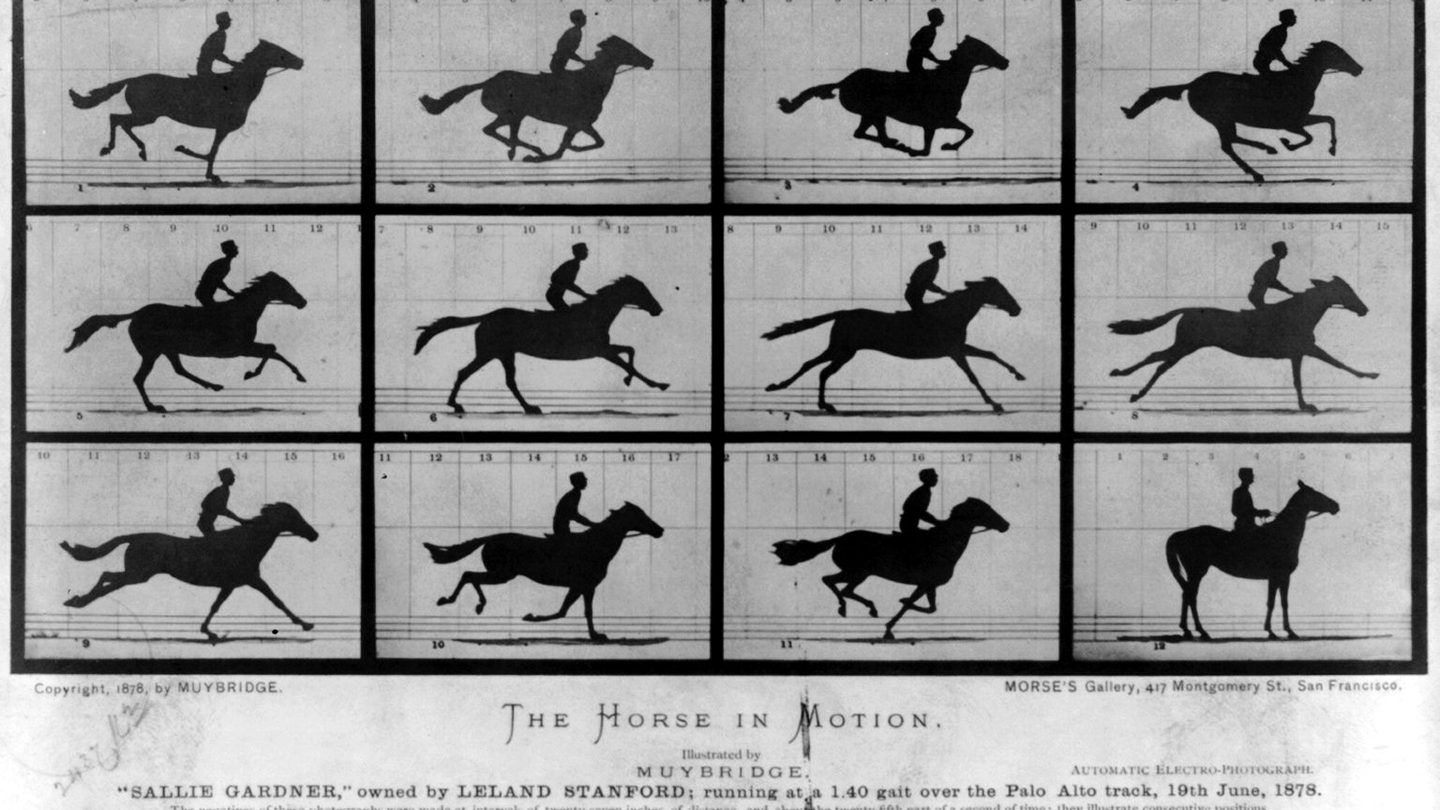
For centuries, painters showed a galloping horse with its front legs stretched forward and its back legs stretched back at the same moment, all four hooves off the ground in a pose closer to a leaping squirrel than anything a horse's skeleton can produce. Leland Stanford, the railroad baron, former California governor, and horse breeder who raced both Standardbred trotters and Thoroughbred runners, became convinced from watching his own horses that painters had it backward, and he wanted a photograph to settle the question.
Stanford hired photographer Eadweard Muybridge in 1872, and it took most of the decade to get a usable result; an 1873 attempt produced only a blurry smear of legs. By 1878, Muybridge had built an electrical trip-wire shutter system and lined up a row of 12 cameras along a whitened stretch of track at Stanford's Palo Alto farm. On June 15, 1878, in front of invited reporters, Stanford's trotter Abe Edgington pulled a sulky across the track at a mile in 2 minutes 20 seconds, its wheel snapping each wire in sequence and firing the cameras roughly 1/1000 of a second apart. A racing mare named Sallie Gardner then ran the same stretch at a pace equivalent to about 1 minute 40 seconds a mile, close to 36 mph, and her saddle girth broke mid-run, visible in the resulting photographs.
The negatives, later published as a card series titled The Horse in Motion, settled the argument. All four of a horse's hooves genuinely do leave the ground at once during a gallop, exactly as Stanford suspected, but not in the extended pose from centuries of paintings. It happens when the legs are gathered underneath the body between strides, a position almost no painter before 1878 had ever depicted. Historian Phillip Prodger has said the popular claim that Stanford had a large bet riding on the outcome is most likely apocryphal, with no primary evidence it ever happened, but the photographic result itself was never in doubt: Muybridge's series became the first example of chronophotography and a direct forerunner of motion pictures.
Why horses switch gaits exactly when they do
Horses don't drift from a walk into a trot at some vague, arbitrary point as they speed up. A 2004 study in the Journal of Experimental Biology, led by Timothy Griffin at the University of Colorado Boulder, put nine horses ranging from 90 to 720 kilograms in body mass and 0.7 to 1.4 meters in leg length on a treadmill and measured both their walk-to-trot transition speed and their oxygen consumption across a wide range of speeds.
Bigger horses switched to a trot at a higher absolute speed than smaller ones did, which sounds obvious on its own. But when Griffin's team converted each horse's transition speed into a Froude number, a dimensionless ratio of speed, leg length, and gravity used to compare gaits across differently sized animals, nearly every horse switched at almost the same value, close to 0.35, regardless of size. That transition point lined up closely with the speed at which trotting stopped costing more oxygen per meter traveled than continuing to walk. A horse doesn't trot because walking becomes physically awkward at higher speeds. It trots the moment trotting becomes the cheaper option, energetically, and every horse in the study made that switch at close to the same value on the same scale. Physics sets hard locomotion limits elsewhere in the animal kingdom too, just from the opposite direction: the same foot-slapping trick that lets a basilisk lizard sprint across open water turns physically impossible for a much heavier animal, a Harvard biomechanics calculation found, because the force needed to keep a bigger body from breaking the surface scales up faster than muscle power can keep up.
How fast the fastest gaits actually go
Average speeds only describe what a horse does most of the time. Under racing conditions, or in a discipline bred specifically for one gait, recorded speeds climb well past the ranges above, though how "fastest ever" gets defined depends on which record-keeping body is doing the timing:
| Horse | Gait | Speed | Record |
|---|---|---|---|
| First Moonflash | Gallop | 44.4 mph | AQHA world record, 440 yards in 20.274s, 2009, matched but not beaten by One Famous Jun in 2025 |
| Winning Brew | Gallop | 43.71 mph | Two furlongs in 20.57s, 2008, Guinness-certified fastest official race speed |
| Bulldog Hanover | Pace | 34.0 mph | 1:45.4 mile, 2022 at the Meadowlands, first sub-1:46 pace in harness-racing history |
| Allegiant | Trot | 33.3 mph | 1:48.0 mile, 2026 at Solvalla in Sweden, current harness-racing trotting record |
The two gallop marks cover the same 440-yard distance but come from different record books: First Moonflash's time is an AQHA world record from specialized Quarter Horse sprint racing, while Winning Brew's is what Guinness World Records certifies as the fastest official racehorse speed under its own verification standard, a genuine case of two different organizations each crowning their own champion over an identical stretch of track. The pace and trot figures, converted here from each horse's official mile time, come from Standardbred horses pulling a two-wheeled sulky rather than carrying a rider, over a full mile rather than a short dash, and both records are recent: Bulldog Hanover's pace fell in 2022, Allegiant's trot only in May 2026, when she became the first mare in 28 years to win Sweden's Elitloppet.
Breeds that move differently
Most breeds share the same four natural gaits and stop there. A handful carry extra gaits that others don't, and a 2012 study in Nature, led by Leif Andersson's group, traced the ability to a single gene: a premature stop codon in DMRT3, nicknamed the 'gait keeper' mutation, found through a genome-wide scan of Icelandic horses and shown in follow-up work to also shape spinal circuit function in mice. Horses carrying the mutation gain access to lateral and ambling gaits that horses without it can't produce naturally, and the same mutation tends to make the transition from trot or pace into a full gallop harder, a genuine tradeoff rather than a pure upgrade.
The Icelandic horse is the clearest example. Alongside the walk, trot, and canter, it naturally performs the tölt, a four-beat lateral gait smooth enough for a rider to sit nearly bounce-free because at least one hoof stays on the ground at every point in the stride, and the flying pace, a two-beat gait with a full suspension phase that can reach around 30 mph over short, straight stretches of 100 to 200 meters and is used specifically in pace racing. Two extra gaits beyond the standard three is why the breed is commonly described as five-gaited.
The American Saddlebred earned the same label through selective breeding rather than a single traceable mutation, adding a collected slow gait and a fast, four-beat rack to the walk, trot, and canter for the show ring. Standardbreds split along a different line entirely: some lines are bred and trained specifically to trot, others specifically to pace, and the two are run as separate careers in harness racing because a horse that excels at one rarely competes well at the other.