.jpg)
The short answer
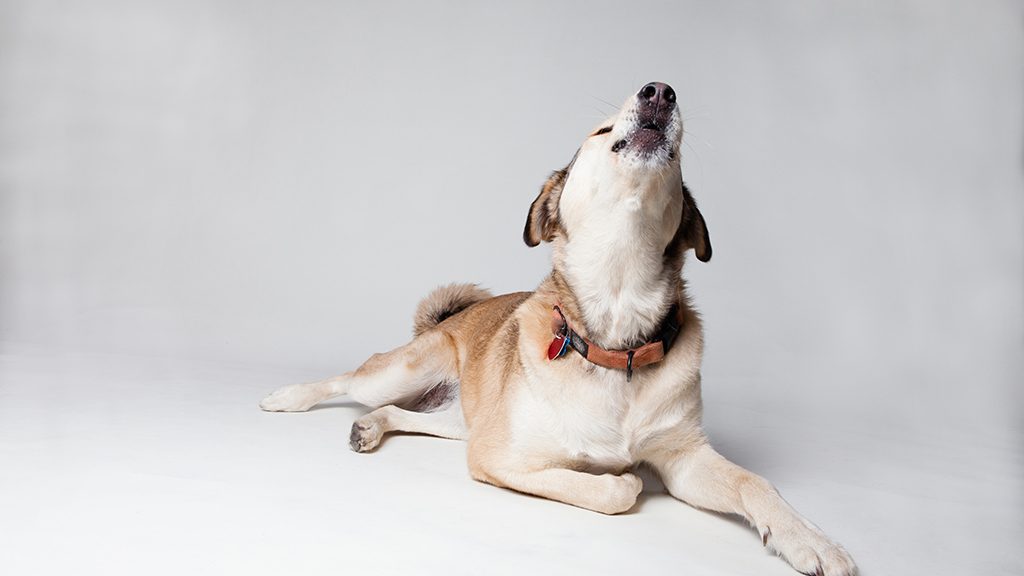
Howling is one of the oldest tools in the canid vocal kit, and dogs inherited it whole from wolves; they never developed a separate version of their own. According to the Wikipedia entry on wolf communication, gray wolves howl to reassemble a pack after a hunt, warn off intruders near a den site, find each other during a storm or while crossing unfamiliar territory, and stay in contact across distances a bark or growl can't cover; under the right conditions, a howl can be heard across roughly 130 square kilometers (about 50 square miles). The sound itself is a long, harmonic tone with a fundamental frequency somewhere between 150 and 780 Hz, layered with as many as 12 overtones, and wolf and dog howls are close enough acoustically that researchers describe them as generally indistinguishable from each other. Not every wild canid relies on the same call: the dhole, a wild dog that split off the wolf-and-dog family branch before it diversified, evolved a whistle-like contact call instead, and the maned wolf, despite its name, lost the long-range howl entirely, leaving domestic dogs and gray wolves as the ones still sharing this particular signal.
One popular explanation doesn't hold up: dogs and wolves do not howl at the moon, and lunar phase has no measurable effect on howling frequency. What does affect it, at least in dogs, turns out to be something nobody had directly tested until recently, whether an individual dog's breed still carries enough of that wolf-era wiring to answer a howl at all.
The same Budapest ethology department has run head-to-head interspecies comparisons before, not just breed-to-breed ones. One study raised pigs and dogs under matched conditions and asked are dogs smarter than pigs at reading a human's cues, a different question from howling, but it fits the same lab's broader habit: actually testing what domestication changed, not just assuming it.
A 2023 study put breed history to a direct test
Fanni Lehoczki and a team based at Eötvös Loránd University in Budapest, working with researchers across Austria, Italy, Spain, Switzerland, and the UK, published the first study to test that question directly, in the journal Communications Biology in February 2023. They played recorded wolf howls, both a single wolf and a full chorus, to 68 purebred dogs from 28 breeds inside an unfamiliar lab room, a setting the researchers chose deliberately: a dog hearing an unknown howl in unfamiliar territory has reason to treat it as a potential intruder's call rather than a friendly one, the same situation a wolf defending a home range would face.
The key variable was what the researchers call "root distance,": how many generations of genetic separation exist between a given breed and the last common ancestor it shares with wolves. Dog breeds split into two rough categories along this axis. So-called ancient (or basal) breeds, a group that includes 13 to 16 breeds such as the Shar-Pei, Basenji, Akita, and Saluki, trace back more than 500 years to a period when dogs were bred mainly for function, with repeated backcrossing to wolves along the way. Modern breeds were built in the last roughly 200 years, once breeders shifted toward standardized appearance and specialized jobs, and share comparatively less recent wolf ancestry. Of the 68 dogs tested, 17 belonged to six ancient breeds specifically: the Shiba inu, Siberian husky, Alaskan malamute, Akita inu, Shih tzu, and Pekingese.
Age turned out to be the hidden variable
Root distance alone didn't predict much. What mattered was root distance combined with age. Across the whole sample, the interaction between the two was statistically significant (χ²(1) = 8.565, p = 0.003), and a simple-slopes breakdown showed why: at a young age (about 1.9 years), breed made no detectable difference in how much a dog howled back (p = 0.59); at an average age (about 4.6 years), the difference was still not significant (p = 0.14); but by around 7.2 years old, dogs from more ancient breeds were replying significantly more than same-aged dogs from modern breeds (p = 0.01). Grouping dogs simply as ancient versus modern sharpened the same pattern (χ²(1) = 10.828, p = 0.001): age raised the reply score in ancient breeds (p = 0.01) but had no effect at all in modern ones (p = 0.55).
In plain terms, a young dog from any breed is roughly as likely, or unlikely, to howl back at a wolf recording. It's only among older dogs that ancestry starts to show, and it shows specifically in breeds that split off from wolves later and stayed genetically closer to them. The researchers read this as a sign that domestication hasn't erased howling from the domestic dog's repertoire uniformly. It's eroded it unevenly, breed by breed, and the erosion only becomes visible with age; it isn't fixed from birth.
Nearly half the dogs got stressed, and breed history split that too
The same playback sessions also tracked stress-related behaviors, things like yawning, lip-licking, and excessive grooming, alongside the vocal responses. Stress behavior showed up in 32 of the 68 dogs, or 47%. Of those 32 dogs, 21 (65.6%) also vocalized during the same test, split across several call types: 15.5% used aggressive, agonistic-style vocalizations, 28.1% used calls apparently directed at their own owner instead of the recording, 37.5% howled or yelped back in a reply pattern, and 46.9% produced sounds the researchers separately classified as stress vocalizations.
Ancient breeds showed significantly more stress behavior than modern breeds, but only during the single-wolf playback segments (χ²(2) = 6.345, p = 0.042); the gap vanished once the recording switched to a full chorus of overlapping wolf howls, where ancient and modern breeds reacted about the same (p = 0.77). Age complicated the stress picture too, in the opposite direction from the reply-howl finding: dogs older than about 8.3 years from modern breeds showed significantly fewer stress behaviors than same-aged ancient-breed dogs, while younger dogs of any breed showed similar stress levels across the board (χ²(1) = 5.113, p = 0.024).
One more wrinkle: neutered males
A separate, smaller effect turned up for sex and reproductive status. The study found a significant interaction between the two (χ²(1) = 5.335, p = 0.021): neutered male dogs howled back for longer than intact males did. That same difference between neutered and intact animals didn't appear in females at all, only in males. The researchers didn't offer a settled explanation for why neutering specifically would lengthen a male dog's howled reply, and it's the kind of finding that reads as a real, measured effect in this dataset without a fully settled mechanism behind it, worth flagging honestly instead of glossing over.
Why your dog howls at sirens, not just at other wolves
None of this lab research involved sirens directly, but the same acoustic logic explains why a passing fire truck or ambulance sets off howling in dogs that would otherwise never hear a wolf. A siren's rising-and-falling wail sits in roughly the same pitch territory as a howl's 150-to-780 Hz fundamental frequency, and a dog's hearing extends well past that range, commonly cited as reaching into the tens of thousands of hertz, far beyond the roughly 20,000 Hz ceiling of human hearing. A sustained, modulating tone in that band is close enough to a howl's acoustic shape that it can trigger the same reflexive vocal response, the same way an unfamiliar dog's bark down the street can set off a chain of answering barks. It's a byproduct of the same long-distance contact-call machinery covered above, not a separate behavior with its own explanation, the same way a cat's purr turns out to serve several different, unrelated functions, not just one, once researchers looked closely at when the sound actually gets used.
Separation-related howling works on a related but distinct track: a dog left alone may howl as a distance call aimed at reuniting with its own "pack," the household it's used to, rather than answering an external sound at all. Distinguishing the two in practice usually comes down to context: howling triggered by a specific sound (a siren, another dog, a wolf recording in a lab) tends to be short and tied to that trigger, while separation howling tends to start after the dog is left alone and persist independent of any outside noise.