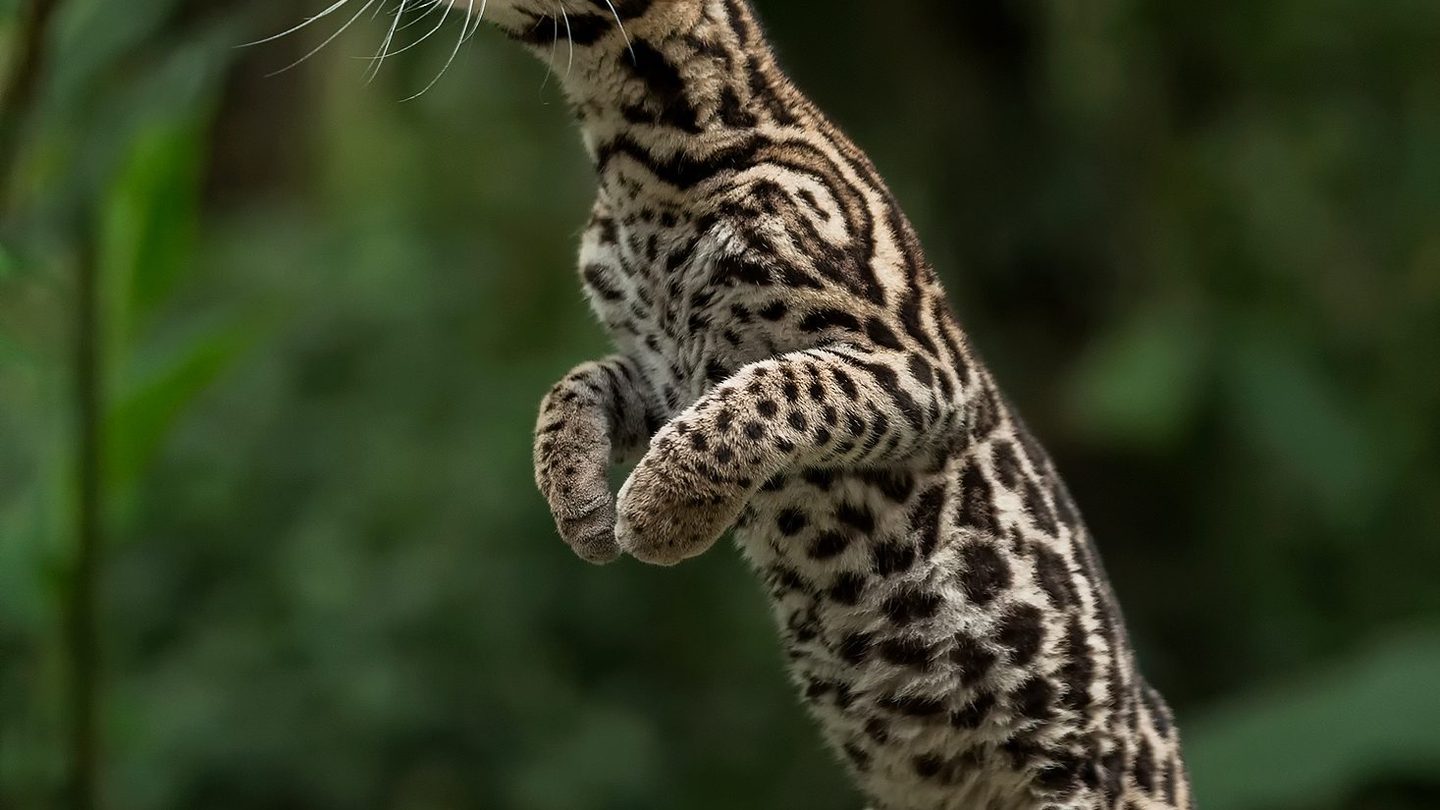

A tarsal joint that rotates 180 degrees
Per figures compiled by the IUCN Cat Specialist Group and the University of Michigan's Animal Diversity Web, adult margays weigh 2.6 to 4.0 kilograms, roughly the range of a housecat, with a head-body length of 46 to 79 centimeters and a tail of 33 to 51 centimeters, proportionally one of the longest tails relative to body size of any small wild cat. That tail does real work: it acts as a counterweight while the animal moves along branches, and its oversized eyes, suited to its largely nocturnal habits, give it the depth perception needed to judge gaps between limbs in the dark.
The trait that actually sets the margay apart from other cats, though, is what its ankle can do. In a 2017 study in Zoology, Miriam Morales and colleagues dissected the ankle musculature of one margay and two Geoffroy's cats (Leopardus geoffroyi) and found differences in the origin, insertion, or muscle belly of 8 of the 10 muscles compared, with at least three of those differences tied specifically to strengthening the muscles that control inversion and eversion of the tarsal joint. The result, the authors conclude, is that the margay is the only arboreal Neotropical felid confirmed able to rotate that joint far enough, close to 180 degrees by several accounts of the study, to climb down a trunk head-first, the way a squirrel does. Geoffroy's cat, by contrast, keeps to more conventional terrestrial habits and lacks the same ankle anatomy. That's a sharper distinction than most "good climber" descriptions in wildlife writing: a rotating ankle joint, not just claws or a light frame, is what a stockier hunter like the fishing cat or the pallas cat doesn't have, and it's why the margay hunts as comfortably in the canopy as jaguars and ocelots do on the ground beneath it. Half a world away, the clouded leopard manages the same headfirst descent down a trunk using an entirely different toolkit: short, powerful legs, oversized paws, and a long tail rather than a uniquely rotating ankle.
Nine-eighteen in the morning: a call built to sound like a monkey in trouble
The hunting behavior that ankle gets used for was documented almost by accident. On October 12, 2005, at Brazil's Reserva Florestal Adolpho Ducke near Manaus, a research team tracking a group of eight pied tamarins (Saguinus bicolor) by radio telemetry watched the monkeys settle into a fig tree to feed. The paper's account puts what happened next at two specific times: at 9:13 a.m., calls resembling the distress cries of tamarin pups began coming from behind a tangle of lianas nearby, and an adult male sentinel climbed partway down to investigate. Five minutes later, at 9:18 a.m., a margay emerged from the vegetation, descending the trunk head-first in what the researchers described as a squirrel-like motion, before dropping to the ground and moving toward the group. A second sentinel recognized the ruse, sounded a genuine alarm call, and the tamarins scattered. The hunt failed.
The observation, published by Fabiano de Oliveira Calleia, Fabio Rohe, and Marcelo Gordo in the June 2009 issue of Neotropical Primates, was reported by the Wildlife Conservation Society as the first scientifically documented case of a wild felid in the Americas mimicking a prey species' vocalization to draw it within striking range. Indigenous hunters and forest residents in the Amazon had long described jaguars and pumas using similar tricks on primates and agoutis, but those accounts had never been confirmed by a research team watching it happen in real time. Co-author Fabio Rohe put the significance this way in the WCS release: "Cats are known for their physical agility, but this vocal manipulation of prey species indicates a psychological cunning which merits further study." The attempt itself failed: pied tamarins post sentinels precisely because predation pressure from birds of prey and cats is constant, and this one caught the deception before it worked. Even so, the researchers argued that an unsuccessful imitation, repeated often enough across a population, could still function as a viable hunting strategy over a margay's lifetime.
Near Threatened since 2015, and thinner on the ground than the range map suggests
The IUCN Cat Specialist Group's 2015 Red List assessment, led by Tadeu de Oliveira and co-authors, classifies the margay as Near Threatened, estimating a population decline approaching but not yet reaching 30 percent over three generations, roughly 18 years, driven mainly by the conversion of native forest to agriculture, pasture, and infrastructure. Density estimates from camera-trap and telemetry studies cited in the assessment run as low as 0.01 to 0.05 individuals per square kilometer across many parts of the range, figures the assessors describe as rare to uncommon rather than the abundant presence a broad Mexico-to-Argentina distribution map might suggest.
Even the Amazon basin, often treated as a stronghold simply because so much forest remains standing there, turns out not to hold unusually dense margay populations once researchers actually go looking. A cat specialized enough to hunt head-first down tree trunks doesn't get a larger buffer against habitat loss just because it's less visible in survey data than a ground-dwelling species would be. If anything, an arboreal specialist adapted to unbroken canopy has fewer alternatives once that canopy is cleared, which is also the practical problem facing the fennec fox: a physiology built for one specific environment doesn't leave much room to improvise once that environment shrinks.