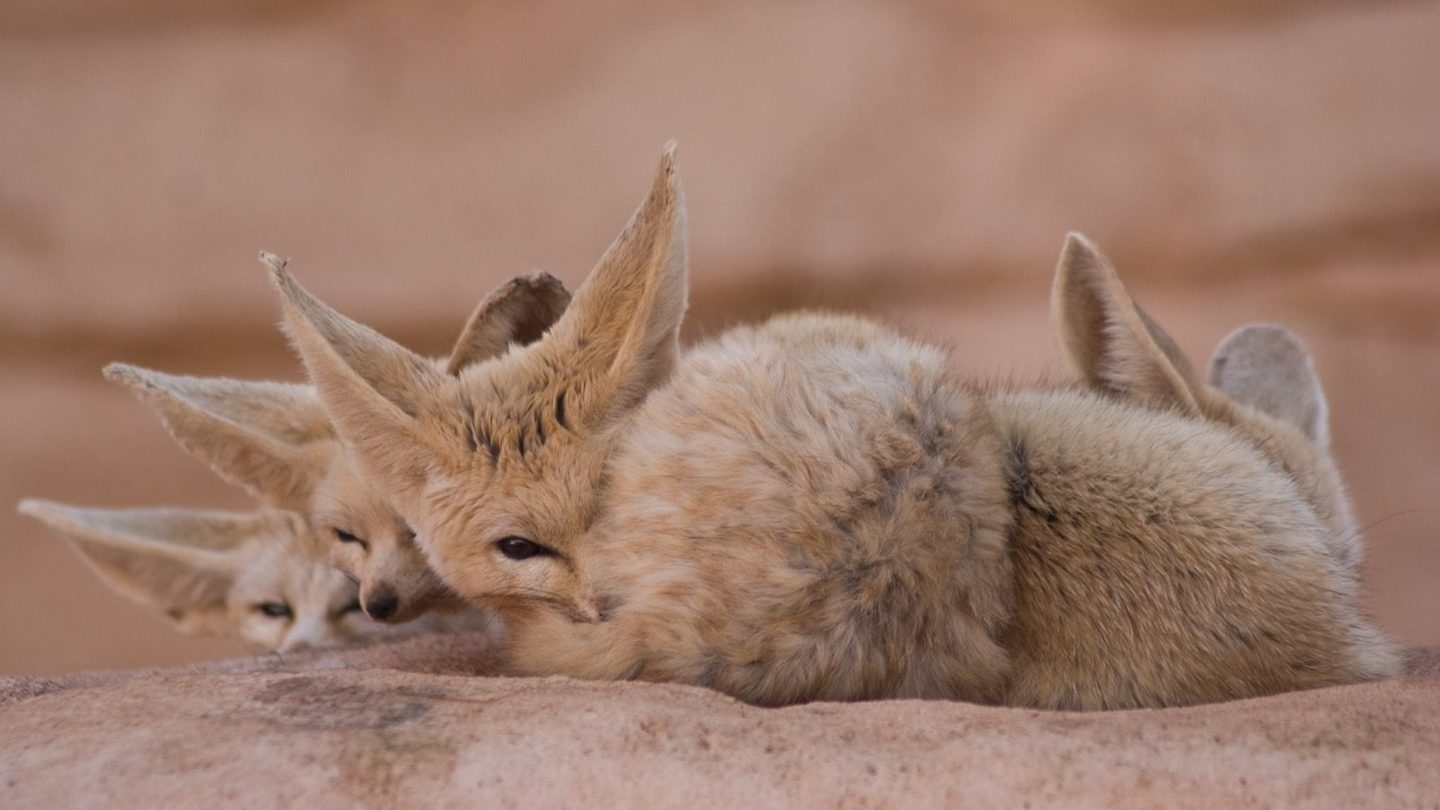

A basal metabolic rate 39 per cent below what its size predicts
Georges Maloiy, Joseph Kamau, Amiram Shkolnik, Mordechai Meir and Ran Arieli ran the fennec fox's thermal physiology through controlled laboratory conditions and published the results in the Journal of Zoology in 1982. Their headline number is stark: basal metabolic rate came out to 0.358 ml of oxygen per gram per hour, which the authors calculated at 39 per cent below the value predicted from the animal's body mass by standard mammalian scaling equations. A fennec fox, at rest in its thermoneutral range, is burning noticeably less energy than an average mammal its size would be expected to.
That low baseline pairs with an unusually wide thermoneutral zone, the temperature band across which an animal can hold its body temperature steady without actively heating or cooling itself. Maloiy and colleagues measured it at 23.4 to 32.0 degrees Celsius for the fennec fox, wider than the zones typically reported for temperate-climate carnivores of similar size, which lets the animal coast through a large part of the desert's daily temperature swing without spending extra metabolic energy on either shivering or panting.
Once ambient temperature climbs past the top of that zone, the mechanism most visible from the outside kicks in. The study found that blood vessels in the ears and legs dilate at the upper end of the thermoneutral range, increasing blood flow to those thinly furred, high-surface-area extremities so that heat carried by the blood can radiate away. The ears are doing real thermoregulatory work, but they are the visible half of a system whose baseline setting, the 39-per-cent-below-predicted metabolic rate, is arguably the harder adaptation to reproduce in an animal living somewhere that is not the Sahara. A famous feature turning out to do something other than what popular reputation assumes isn't unique to this fox, either: the clouded leopard's oversized canine teeth converge independently on extinct sabertooth skull features, a resemblance built by a separate evolutionary route rather than shared ancestry.
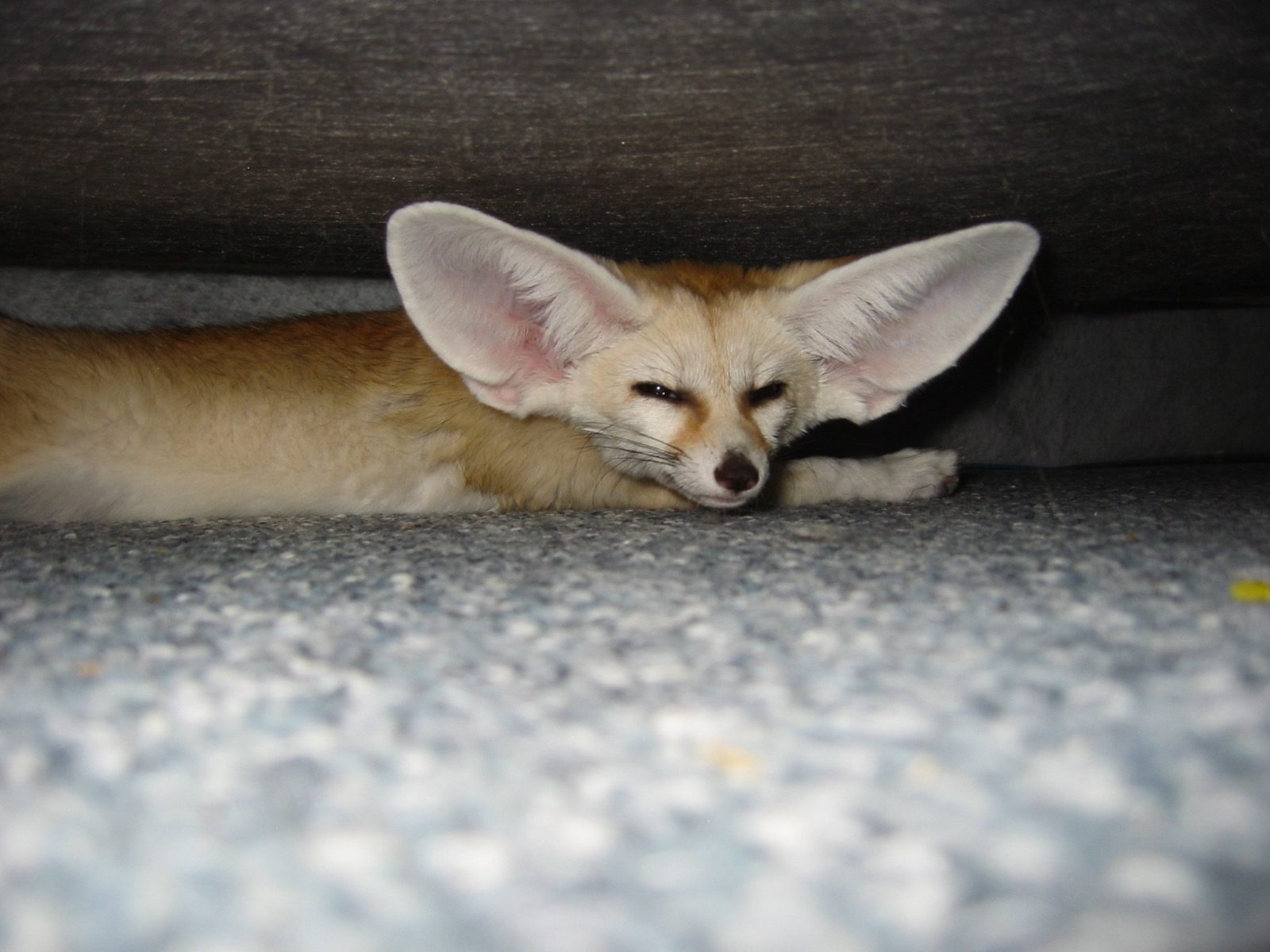

Kidneys that cut urine water loss to 59 per cent of expected
Ursel Noll-Banholzer published a companion study in Comparative Biochemistry and Physiology A in 1979, this one focused on water balance and kidney structure, not heat. The kidneys themselves are unusual in shape: the paper reports a relative medullary thickness of 5.35, a measure of how much of the kidney is given over to the tissue responsible for concentrating urine, and describes fennec urine concentrations as exceeding what has been reported for other carnivores.
The practical effect shows up in a water-loss figure. Under normal conditions, daily urinary water loss in the fennec fox came out to 59 per cent of the value predicted for a carnivore of its body size, meaning the kidneys are already conserving water well below the mammalian baseline before the animal is under any particular stress. Push the animal into dehydration and the number moves further: Noll-Banholzer's data show water lost through urine dropping from 45 to 48 per cent of total water loss under normal conditions to 27 per cent when water is restricted, with evaporative water loss barely changing in comparison. The kidney, not the lungs or skin, is where the animal makes its adjustment. Under these dehydration protocols the animals in the study were able to hold or even gain body weight without any water or water-rich food, a result the paper attributes squarely to renal concentrating capacity rather than behavioral water-seeking.
This is the trait a home environment cannot really substitute for by supplying constant water, because the adaptation is about what the kidney does with whatever water is available, not about total intake. An animal built to run its urine at 27 per cent of normal water loss under stress is not adapting to captivity so much as tolerating a permanent surplus it never evolved to expect.
The 2023 genome study that put names to the adaptation
Physiology measurements from 1979 and 1982 describe what the fennec fox's body does. A 2023 paper in Nature Ecology & Evolution, by Joana Rocha, Pedro Silva, Nuno Santos, Mónia Nakamura, Sandra Afonso, Abdeljebbar Qninba, Zbyszek Boratynski, Peter Sudmant, José Brito, Rasmus Nielsen and Raquel Godinho, went looking for which genes were doing it. The team sequenced whole genomes from four North African Vulpes species, including five fennec fox individuals, and estimated that the fennec lineage diverged from other members of the genus between 4.8 and 6.2 million years ago.
Scanning for signatures of selection, the authors report finding repeated signals in genes affecting renal water homeostasis in both the fennec fox and the closely related Rueppell's fox, the two most extreme desert specialists in the genus they sampled. Their top candidate in the fennec genome is KIRREL1, a gene that encodes a protein produced in kidney podocytes and involved in the normal development and function of the glomerular filtration barrier, the structure that determines what gets filtered out of the blood into urine. A second gene, CACNA1H, also carries a selection signature in the same functional category. The paper additionally found evidence of introgression, meaning historical interbreeding and gene flow, between the fennec fox and Rueppell's fox despite the two lineages being highly divergent, which the authors interpret as one route by which desert-adapted gene variants moved between species.
Put the two literatures together and the picture holds together, not by coincidence: a kidney structure measured directly in 1979, a whole-body metabolic and thermal profile measured directly in 1982, and a genomic signal in 2023 landing on the same organ system as the reason why. Three independent methods, four decades apart, converge on the fennec fox's kidneys as the center of its desert adaptation, the kind of resolution that comes from testing a claim directly rather than repeating it. That approach doesn't always converge so cleanly: whether Spinosaurus could actually swim has also been tested directly, with flume experiments, CT-based flesh models and bone-density surveys, and after all three the debate is still unresolved.
Legal to buy in a handful of states, a restricted welfare species in others
None of that physiology is mentioned on most listings selling captive-bred fennec fox kits, and the legal status of owning one varies by jurisdiction across the United States, with no single federal rule governing it. The Convention on International Trade in Endangered Species places the fennec fox in Appendix II, which requires export permits and documentation for international commercial trade but does not regulate whether an individual state allows private ownership once an animal is already in the country.
California is a clear example of a state that does not allow it. The California Code of Regulations, Title 14, Section 671, lists "Family Canidae--All species" under a restriction code, with the regulation itself specifying that domesticated dogs are exempted and nothing else in the family is. The same section defines what that restriction code means: "Mammals listed to prevent the depletion of wild populations and to provide for animal welfare are termed 'welfare animals', and are designated by the letter 'W'." The fennec fox is not banned in California because it is considered dangerous. It is restricted under a category whose own regulatory language is about wild-population depletion and welfare, the same two concerns that show up independently in how conservation groups describe the exotic pet trade in this species. The same section of California code restricts a very different popular exotic pet for a very different reason: the axolotl is listed there too, not for welfare or depletion but because it can hybridize with a native salamander species, a reminder that one regulation can cover unrelated animals for unrelated biological reasons.
Other states set their own rules, some allowing ownership without a state-level permit and some prohibiting it outright, and county or municipal ordinances can add further restrictions even where state law allows the animal. That patchwork means the honest answer to whether a fennec fox is legal to own is that it depends entirely on the specific state and sometimes the specific county, checked against current law, not assumed from a general reputation as a small, non-dangerous, desert-adapted animal.
What "captive-bred" does not tell you about where the breeding stock came from
The International Fund for Animal Welfare's assessment of the species in the exotic pet trade does not soften its language. "In North Africa, fennec foxes are caught for exhibition or to be sold as pets to tourists," the organization states, adding that this practice "is dangerous for the population, because it can create and increase demand for the species, prompting the capture of more individuals." On the welfare side of the same capture process, the assessment is direct: "It also causes needless deaths, because trappers kill mother foxes to take their young."
That claim describes wild capture specifically, not the captive-breeding operations that supply most of the pet fennec foxes sold in the United States, and IFAW's own assessment distinguishes the two while still flagging the wild trade as "a growing concern." The IUCN's most recent formal assessment of the species, led by Tim Wacher, Kathy Bauman and Fabien Cuzin in 2015, lists the fennec fox as Least Concern on the basis that it remains relatively widespread across the sandy deserts and semi-deserts of northern Africa with no known range-wide threat driving a population decline. The same assessment is explicit that current population statistics are not available and that the Least Concern rating rests on the species being observed as commonly trapped and commercially sold, an indirect proxy for abundance, not an actual headcount.
Put those together and the reassurance a buyer gets from "Least Concern" and "captive-bred" is thinner than either phrase implies on its own. The conservation status is built on incomplete data, not a confirmed stable count, and the welfare organization tracking the pet trade specifically names wild capture, including the killing of mothers to obtain kits, as an ongoing practice feeding demand for the species as a pet, separate from whatever a given breeder's own stock history happens to be. A gap this wide between an animal's marketed reputation and what the record actually supports is not unique to the fennec fox; it is the same gap that let a single photograph of an oversized desert arachnid spawn more than two decades of false claims about speed, venom, and behavior before anyone checked.