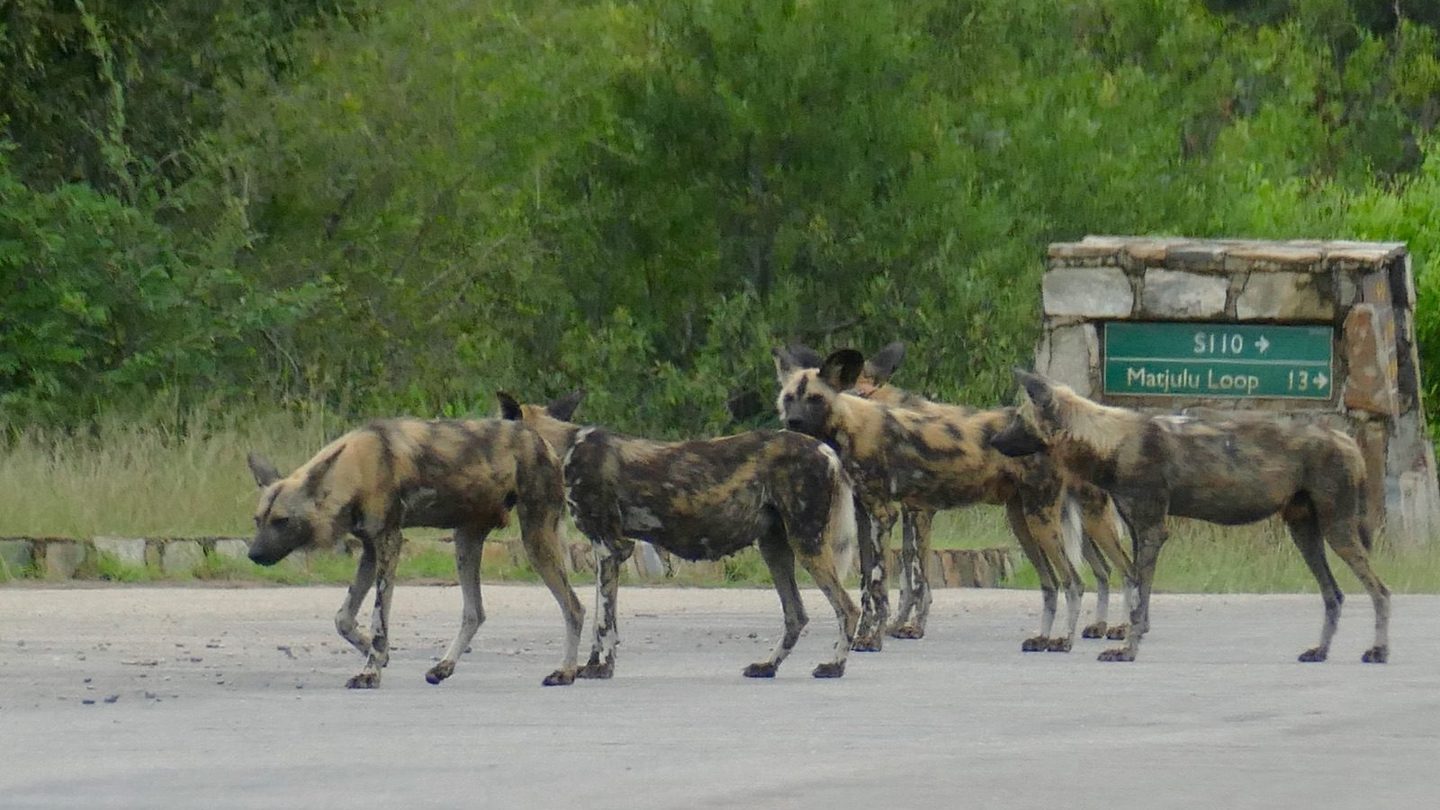
_pack_..._(53642738868).jpg)
The only species in its genus, four toes short of a wolf
African wild dogs look like they belong in Canis, the genus that holds wolves, coyotes, jackals, and domestic dogs, but they don't. Lycaon pictus is the sole living member of its own genus, Lycaon, named by the naturalist Joshua Brookes in 1827, and the split from the wolf-like canids runs deep enough that there is no prospect of a Lycaon and a Canis interbreeding. The clearest physical tell is in the feet: Canis species carry five toes on each front foot, including a vestigial dewclaw, while Lycaon has only four, having lost that fifth digit entirely. Its teeth carry the other half of the distinction. The genus is built around a hypercarnivorous dentition, teeth shaped for slicing meat rather than the more generalized bite of a wolf, and that dental specialization, not raw speed, is what a 2010 fossil study leaned on to trace where the lineage came from. Lycaon isn't the only canid genus reduced to one living species: South America's maned wolf is likewise the sole survivor of its own genus, though what sets it apart from Canis has far more to do with its fruit-heavy diet and unusual urine chemistry than with teeth or toes.
Adam Hartstone-Rose, Lars Werdelin, Darryl de Ruiter, Lee Berger, and Steven Churchill described that fossil evidence in the Journal of Paleontology in 2010: a new extinct species, Lycaon sekowei, recovered from South Africa's Sterkfontein Valley, the same general area that produced the Australopithecus sediba remains. Jaw fragments still holding teeth in place, dated to roughly 1.9 to 1.6 million years old, showed peculiar accessory cusps on the premolars found only in the genus Lycaon, and in a direct comparison those premolars resembled Lycaon pictus more closely than either a modern gray wolf's or those of the extinct fossil wolf Xenocyon. A second, roughly 1-million-year-old specimen, tentatively assigned to the same species, preserved close to 40% of a skeleton, by far the most complete fossil canid skeleton ever recovered from Africa. It carried a working tooth pattern essentially matching a modern wild dog's, but its forefoot still included part of a first metacarpal, the bone behind the digit that living African wild dogs have lost outright. If that specimen really does belong on the wild dog's direct lineage, the authors noted, it implies the specialized diet came first and the four-toed running foot came later, a sequence opposite to what a simpler story of "built for endurance running" would suggest. The authors were careful to flag how much rests on that if: the tentative species assignment and the general scarcity of African fossil canids mean Lycaon sekowei is, in their own words, the best candidate identified so far for a wild dog ancestor, not a confirmed one. Reconstructing gait from bone shape alone is always an inference; in a living animal, the beat count and footfall order behind each of a horse's four natural gaits can be measured directly, stride by stride, in a way no fossil skeleton allows.
GPS collars put the individual kill rate at 15.5%, not 80%
"They have high success rates when hunting (around 80%) thanks to their strong teamwork," reads the African wild dog page on IFAW's website, and versions of that number, sometimes 80%, sometimes a 60-to-90% range, circulate across enough conservation and wildlife sites that it functions as the species' signature statistic: the most successful hunter in Africa, beating lions and cheetahs by a wide margin. Older field studies, largely built on visual observation of dogs hunting across open East African grassland, are where that reputation comes from.
Tatjana Hubel, Julia Myatt, Neil Jordan, Oliver Dewhirst, J. Weldon McNutt, and Alan Wilson tested it with instruments, not binoculars. Publishing in Nature Communications in 2016, the team fitted high-resolution GPS and inertial sensors to every one of the six adult members of a single pack in the mixed woodland of northern Botswana, terrain closer to what most of the species' remaining range actually looks like than the grasslands earlier studies drew from. The fine-scale movement data told a different story: dogs made repeated short-distance hunting attempts rather than sustained pursuits, and any individual dog's own attempts ended in a kill only 15.5% of the time. What kept the pack fed wasn't a high per-dog success rate; it was volume and sharing. The paper reports no instances of the long-distance, coordinated group chases that earlier accounts had described as the wild dog's hallmark hunting style, and the authors argue that in the woodland habitat most remaining wild dogs actually live in, several dogs launching simultaneous, opportunistic short chases at different prey, then sharing whatever any one of them catches, produces the group's high overall feeding success without any single dog's attempts succeeding especially often. The 80% figure isn't necessarily wrong for open grassland packs under the conditions older studies watched; it just isn't what a pack of dogs living in the denser, more typical habitat GPS-tracked in 2016 actually did.
Packs vote on whether to move by counting sneezes
Before a resting pack sets off to hunt, African wild dogs perform a stereotyped "rally," a burst of greeting, head-touching, and running flank to flank that raises the group's energy before a collective departure. Not every rally ends with the pack actually moving, and for a long time nobody had a clear account of what tipped a rally from just excitement into an actual departure.
Reena Walker, Andrew King, J. Weldon McNutt, and Neil Jordan found the answer by recording audio and behavior across five packs, averaging 8.80 adults per pack, in and around Botswana's Moremi Game Reserve in the Okavango Delta, from June 2014 to May 2015, publishing the results in the Proceedings of the Royal Society B in 2017. Whether a rally succeeded in getting the pack to leave turned out to be predictable from one specific signal: a minimum count of audible rapid nasal exhalations, sneezes, produced by participants during the rally. That minimum wasn't fixed. When a dominant animal initiated the rally, the researchers' own data showed rallies never failed once at least three sneezes had occurred. When a lower-ranking dog initiated instead, a minimum of ten sneezes was required to reach the same near-certain success, a quorum more than three times higher. Dominant animals still carry outsized influence, in other words, but they don't have a veto: enough sneezing from the rest of the pack can carry a decision a dominant animal didn't start, a form of negotiated consensus, in effect a vote conducted through a physical signal, that the researchers found operating inside a species usually described as strictly hierarchical.
Researchers were blamed for a pack's disappearance. The evidence says otherwise.
The IUCN's 2020 Red List assessment puts the global African wild dog population at roughly 6,600 adults, of which only about 1,400 are classified as mature individuals, spread across 39 subpopulations ranging in size from as few as 2 to as many as 276 mature animals. The assessors themselves caution that few subpopulations have been systematically monitored and that the resulting numbers should be treated with considerable caution given how much wild dog populations naturally fluctuate. The species has held Endangered status since 1990, with habitat fragmentation, conflict with livestock owners, and infectious disease named as the ongoing drivers. That kind of caveat isn't limited to a wide-ranging Endangered species that's hard to count across remote habitat: the IUCN's most recent assessment of the fennec fox, rated Least Concern rather than Endangered, is equally explicit that no population statistics exist for that species either, resting its classification on how often the animal turns up trapped and sold, not on any actual headcount.
One of the starkest wild dog population collapses on record happened in Serengeti National Park in 1991, when the resident pack disappeared entirely within a matter of months. In 1992, researcher Roger Burrows proposed a controversial explanation that came to be called the Burrows hypothesis: that the stress of being darted, immobilized, and radio-collared by researchers had reactivated a latent rabies infection in the dogs, meaning the study of the population had effectively killed it. The claim was influential for years, but the data needed to test it directly didn't exist until wild dogs had been living and being studied alongside Serengeti again for over a decade. Craig Jackson and colleagues ran that test in a 2019 Ecology and Evolution paper, examining outcomes for every wild dog handled in the ecosystem between 2006 and 2016. If the hypothesis were correct, the dogs subjected to the most handling and longest confinement should have died at the highest rates. The opposite happened: 121 handled wild dogs survived at 87.6% past 12 months overall, and the subset of 67 dogs that endured the most prolonged stress, immobilization followed by capture, transport, and a translocation enclosure averaging 313 days, survived at 95.5%. Dogs that were only briefly immobilized and released, without the longer confinement, survived at just 77.8%, a lower rate despite less handling stress. Combined with a stable number of packs in the ecosystem over the following decade and no recolonization of the park itself, the authors concluded the evidence pointed away from researcher-induced disease and toward heightened competition from lions and hyenas, working alongside disease that was circulating in the ecosystem independent of any research activity.
That reversal, a widely repeated explanation for an animal's decline turning out to be backwards once someone tested it directly against outcome data, isn't unique to this species. The fishing cat went through something similar from the opposite direction methodologically: older VHF radio-collar studies had to manually track down a signal and regularly lost cats that had wandered out of range, mechanically producing home-range estimates far smaller than what a 2025 GPS study, recording locations automatically on a fixed schedule, actually found. In both cases the older, cruder method was biased in a specific, predictable direction, and it took fitting the same animals with better instruments to find out which way. Conservation status itself can shift for the same underlying reason: the IUCN downgraded the Pallas's cat from Near Threatened to Least Concern in 2020, but that change came from researchers getting better range and population data, not from the cat's actual numbers improving. Better data moved the label in one case and cleared the researchers in the other; neither meant the animal itself was suddenly doing better.