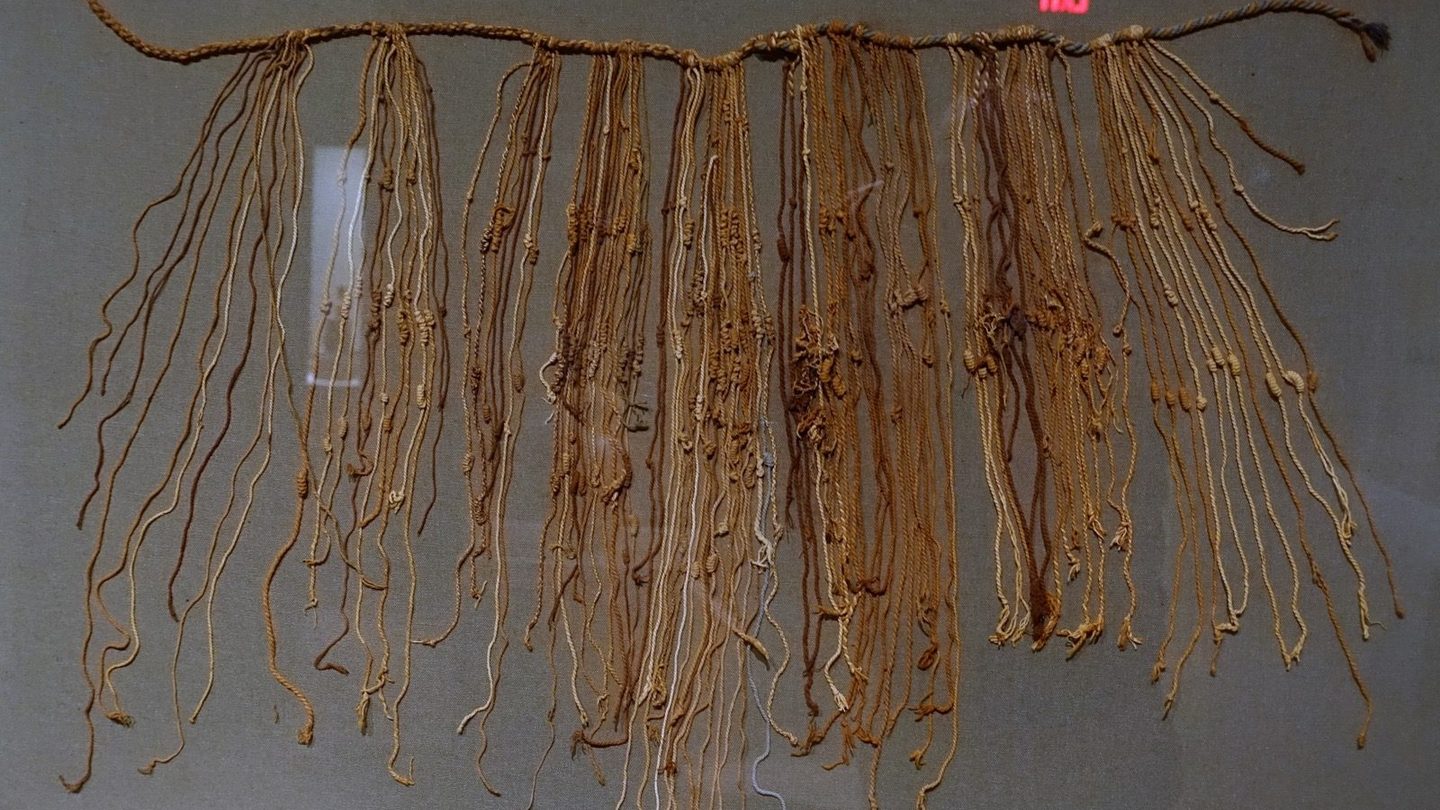
,_a_main_cord_with_top,_subsidiary,_%26_tertiary_cords,_Inca,_Peru,_Late_Horizon,_1476-1534_AD,_cotton,_plant_%26_camelid_fiber,_indigo_%26_red_dye_-_Dallas_Museum_of_Art_-_DSC04704.jpg)
A knot is a digit: how the numbers actually work
A quipu is built from a thicker primary cord with pendant cords hanging from it, each pendant tied with clusters of knots at different heights. Anthropologists Marcia and Robert Ascher spent decades, starting in the 1970s, cataloguing hundreds of quipus held in museum collections and worked out that the knot clusters follow a base-10 positional number system, laid out along each cord the way digits are laid out along a written numeral.
Three knot types carry the value. A long knot, made with multiple turns of fiber before it is pulled tight, records the units digit, with the number of turns giving the digit's value. A simple overhand knot records any digit in a higher decimal place, tens, hundreds, thousands, again with the number of turns setting the value, and knot clusters are strung from the top of the cord down, with units nearest the bottom. Because a long knot with only one turn would be indistinguishable from a simple knot, quipu makers used a separate figure-eight knot whenever the units digit was exactly one. Zero is not a separate knot at all: it is the absence of one in a position where a knot would otherwise sit, the same functional role zero plays in a written place-value numeral. A different ancient culture invented its own version of that same absence-as-zero idea independently: the Maya numeral system's zero symbol predates the oldest confirmed Maya calendar date by roughly two centuries, one of very few civilizations anywhere to arrive at the concept on its own.
That system alone lets a quipu encode large sums with the same information density as written numerals, which is exactly how the Inca state used most surviving quipus: as census and tribute records, storehouse inventories, and administrative accounts for an empire that, at its height in the early 1500s, governed an estimated 10 to 12 million people without a script in the conventional sense.
A Harvard freshman matched 132 knots to 132 names
Numbers alone would already make a quipu valuable evidence, but the Santa Valley case went further, into a domain quipus were long assumed not to reach: matching specific knots to specific named individuals in an outside written record. Gary Urton, an anthropologist at Harvard, had for years pursued a hunch that a set of six quipus, said to have been recovered from a burial in Peru's Santa Valley and now held in museum collections, corresponded to a colonial-era administrative document from the same region.
In the spring of 2016, Harvard undergraduate Manny Medrano volunteered to test the idea against a 1670 revisita, a Spanish colonial tribute census, covering settlements near the town of San Pedro de Corongo in the lower Santa Valley. The census named 132 tributaries across six ayllus, kin-based social groups. Medrano found that the six quipus carried exactly 132 pendant cords in total, distributed across six clusters that matched the census's six ayllus, and that the knot sums on the cords tracked the tribute amounts the Spanish document recorded as owed by each named person. He and Urton also found that the direction a cord's fiber was twisted, described as recto or verso, appeared to encode which of two larger social divisions, hanan or hurin, each ayllu belonged to.
Medrano and Urton published the full analysis as "Toward the Decipherment of a Set of Mid-Colonial Khipus from the Santa Valley, Coastal Peru" in the journal Ethnohistory in January 2018. It remains one of the few cases where a quipu's structure has been checked, cord by cord, against an independent written document, not just interpreted in isolation.
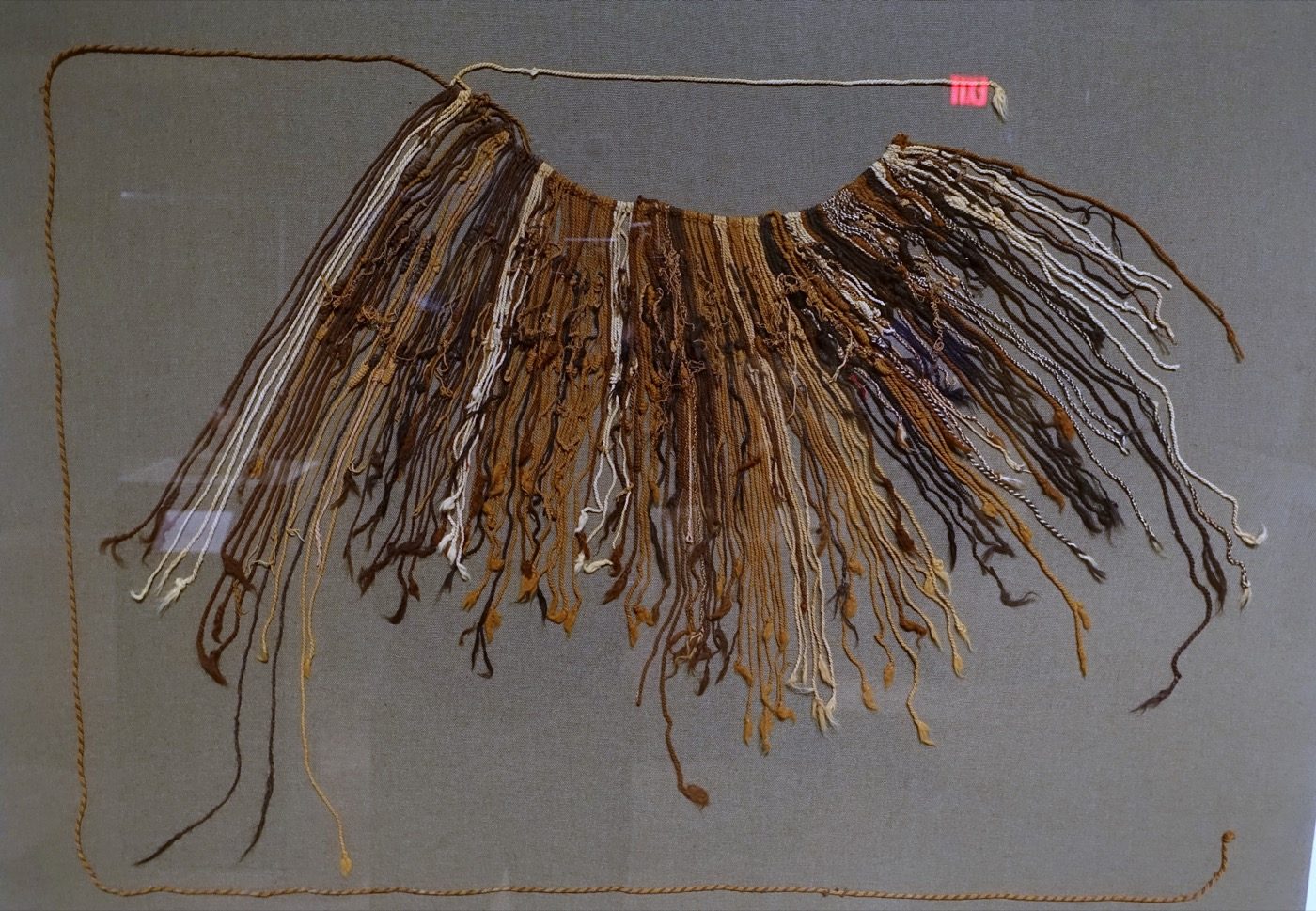
_composed_of_two_main_cords_with_subsidiary_and_tertiary_cords,_Inca,_Peru,_Late_Horizon,_1476-1534_AD,_cotton,_plant_fiber,_indigo_dye_-_Dallas_Museum_of_Art_-_DSC04703.jpg)
The 95-symbol case for quipus as language, not just numbers
Whether any quipu ever recorded language, not just numerical and categorical data, has been the field's central dispute for decades. Sabine Hyland, an anthropologist then at the University of St Andrews, reported the strongest case yet in "Writing with Twisted Cords: The Inscriptive Capacity of Andean Khipus," published in Current Anthropology in June 2017.
Hyland worked with two quipus kept by the village council of San Juan de Collata, in a remote part of the Peruvian Andes, understood locally as 18th-century letters exchanged by local leaders during a revolt against Spanish colonial authority. Unlike the standardized numerical cords used for imperial Inca accounting, the Collata cords showed 95 distinct combinations of fiber type, color, and knot direction, a symbol count that falls within the range typical of logosyllabic writing systems, where each symbol represents a syllable or word rather than a single letter sound. That is a meaningfully larger and more varied inventory than the numerical and categorical cords used in tribute and census quipus like the ones from the Santa Valley, and it is the basis for calling the Collata pair the first plausible instance of phonetic Inca writing.
Hyland has been careful about the limits of the finding: the Collata cords are unusual, non-standardized, and belong to one specific local village tradition, not the empire-wide administrative system, so the result does not establish that quipus in general functioned as full writing. What it does establish is that the physical medium, knotted and colored cord, was flexible enough to support that kind of system when a community had reason to build one.
Why so few survive, and why that was deliberate
The gap in quipu scholarship is not primarily a failure of analysis; it is a shortage of surviving material, and that shortage traces to a specific colonial-era decision. The Third Council of Lima, a church synod that met from 1582 to 1583 and issued its findings that year, condemned quipus as idolatrous objects and ordered them destroyed as part of a broader campaign against indigenous religious and administrative practices. Quipu use did not stop immediately or everywhere; it persisted for generations in some rural communities, including, centuries later, the Collata village tradition Hyland documented. But the decree marks the point at which quipus went from a routine tool of imperial and local administration to a suppressed practice, and an unknown but likely large number were destroyed or simply left to decay once no one was formally responsible for maintaining them.
Cataloguing efforts, including Gary Urton's Harvard-based Khipu Database Project and the newer, publicly accessible Open Khipu Repository, put the number of quipus known to survive today at roughly 1,300 to 1,400 across more than 140 museums, universities, and private collections in over 20 countries, with the Ethnological Museum in Berlin holding the single largest collection. That is the entire evidentiary base for a system that, at its administrative peak, must have generated vastly more cords than survive, which is part of why any single well-documented match, like the Santa Valley census, carries outsized weight in the field.
A knotted cord from 2,000 years before the Inca
Quipus are usually associated with the Inca Empire, which rose in the 15th century, but the earliest known example is roughly four thousand years older. Archaeologists working at Caral, a major urban site of the Norte Chico (also called Caral-Supe) civilization on Peru's arid coast, recovered a bundle of knotted, dyed cotton cords dated to approximately 2500 BCE, making it the oldest known example of the general technology.
The Caral cords cannot be read using the Ascher decimal system or any other framework developed for Inca-era quipus, and researchers have not established what information, if any, they were built to hold: possibilities discussed in the archaeological literature include labor accounts, ritual or calendrical records, and kinship data, but none has been confirmed. Norte Chico is notable for having built large-scale urban centers without producing pottery or any conventional script, and the Caral cords are treated as a singular, undeciphered find, not proof of an unbroken record-keeping tradition running continuously from 2500 BCE to the Inca period roughly four thousand years later.
Where decipherment stands now
The honest summary of the field, repeated by researchers on multiple sides of its disputes, is that no fully narrative quipu, one that can be read start to finish the way a written document can, has yet been deciphered. Numerical quipus are well understood thanks to the Aschers' work. A small number of quipus, the Santa Valley set and the Collata pair among them, have yielded specific, checkable results because they could be matched against an independent record or showed an unusually rich symbol set. The much larger remaining body of quipus, most of them separated from any accompanying document that survived alongside them, has resisted a general reading method.
Recent work has shifted toward computational approaches applied across that larger body at once. The Open Khipu Repository, an open digital database of quipu measurements built by computational anthropologist Jon Clindaniel, has let researchers run statistical pattern-mining across hundreds of quipus simultaneously rather than one at a time. A 2026 analysis built on that repository, "Structural Pattern Mining in Inka Khipus," applied unsupervised clustering to the dataset and reported three well-separated structural groups, identified cord twist direction as a marker of centralized Inca imperial manufacture as opposed to regional or colonial-era production, and offered an independent statistical check that supported the Santa Valley moiety pattern Medrano and Urton had proposed from a single case. Work like this does not decipher new quipus on its own, but it tests and extends conclusions drawn from individual cases like Santa Valley across the wider surviving corpus, and narrows down which structural features are worth pursuing in future case-by-case decipherment.
Checking a widely repeated claim against the actual primary evidence, rather than against how many times it has been repeated, is the same approach FactCrumbs has used on claims that seemed settled in other fields entirely: the unmeasured top speed attached to camel spiders and the necrotic-bite reputation that 45 confirmed wolf spider bites never actually produced both turned out differently once someone checked the primary record and set the folklore aside.