
Three symbols, stacked vertically
The system runs on three glyphs. A dot stands for one, a horizontal bar stands for five, and a stylized shell shape stands for zero. Combining dots and bars covers every value from zero through nineteen: four dots and three bars, for instance, reads as 4 + 15 = 19, the highest single-position value before the system carries over into the next place.
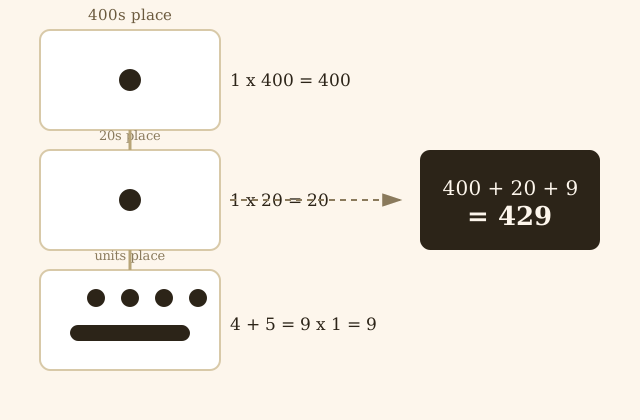
Place value runs vertically instead of horizontally. The bottom row holds the units, worth 1 each; the row above holds multiples of 20; the row above that holds multiples of 400 (20 x 20); and so on up the column. A number like 429 would be written as a single dot in the 400s row, a single dot in the 20s row, and a bar with four dots, nine, in the units row: 400 + 20 + 9 = 429. Reading a Mayan numeral means reading up the stack and multiplying each glyph's dot-and-bar value by the power of 20 assigned to its row, then adding the results together.
This is a true positional system in the same structural sense as Hindu-Arabic numerals, where the digit '3' means something different in '30' than in '300' purely because of where it sits. The shell-zero glyph is what makes that possible: without a symbol to mark an empty place, there would be no way to distinguish a number with a gap in the middle of its place-value stack from one without.
Positional recording without an alphabet is not unique to Mesoamerica. Roughly 2,500 miles south, the Inca built a base-10 positional system out of knotted cords instead of written glyphs, with an absent knot standing in for zero the same functional role the shell glyph plays here, developed independently and centuries after the Maya version.
Twenty is a person, not just a number
Base-20 counting shows up in the words themselves. In K'iche', a Mayan language spoken in the Guatemalan highlands, the word for twenty, winäq, is the same word used for 'person.' The same root, winik, appears across Classic-period Maya inscriptions (250-900 CE) carrying both meanings, and the pattern holds in related Mayan languages under close cognates.
The likeliest explanation, and the one most linguists and epigraphers converge on, is anatomical: ten fingers plus ten toes gives a complete count of twenty digits per person, and the vigesimal system generalizes that full-body count into a number base the way base-10 systems elsewhere generalize a two-handed count of ten fingers.
The zero that wasn't Maya first
The claim that the Maya independently invented the number zero gets repeated often enough that it functions as settled trivia. The archaeological record complicates it. The Long Count date most researchers accept as the oldest securely read in Mesoamerica, on Stela 2 at the site of Chiapa de Corzo in Chiapas, Mexico, corresponds to 36 BCE, and it is carved in the Isthmian (Epi-Olmec) script, not Maya script. A second stela, also numbered Stela 2, at Takalik Abaj in Guatemala, carries a Long Count reading that may be even older, but its surface is damaged enough, and its period glyphs faint enough, that specialists still dispute exactly what date it records.
Epi-Olmec culture is a distinct, later tradition from the Olmec civilization it is named for. The Olmec heartland flourished roughly 1200 to 400 BCE; Epi-Olmec culture, centered on Mexico's Papaloapan river basin in what is now Veracruz, developed afterward, from around 300 BCE to 250 CE, and unlike the Olmec it left behind an actual writing system. Several of the oldest known Long Count dates in Mesoamerica come from sites on or west of the Maya region's edge, which is the main reason most researchers treat the Long Count calendar, and the positional zero-bearing notation that comes with it, as predating the Maya's own adoption of it rather than originating with them.
A 2026 dig pushed the Maya record back, but not far enough to close the gap
For decades, the earliest artifact securely attributed to Maya culture and bearing a Long Count date was Stela 29 at Tikal, in Guatemala, read as CE 292. That changed in 2026, when a team led by Kenichiro Tsukamoto of the University of California, Riverside, and Javier López Camacho of Mexico's National Institute of Anthropology and History (INAH) published new findings on Stela 46 at El Palmar, a Maya site in Campeche, Mexico.
The stela's surface had eroded too badly for earlier researchers to read; the El Palmar Archaeological Project team spent nearly two decades on the site before photogrammetry and high-resolution 3D scanning let them recover the glyphs on its damaged sides. The result was a Long Count date of 8.7.1.0.0, equivalent to August 31, CE 180, making it the oldest confirmed Long Count inscription anywhere in the Maya lowlands, 112 years earlier than the Tikal record it displaced. The team published the analysis in Ancient Mesoamerica in 2026.
Line the dates up and the gap is still wide. Chiapa de Corzo's Epi-Olmec zero is usually dated to 36 BCE. El Palmar's earliest confirmed Maya zero dates to CE 180. Counted the way historians count a span crossing from BCE into CE, with no year zero in between, that comes to roughly 215 years between the oldest securely read use of the notation in the region and the oldest confirmed Maya use of it, a gap the 2026 find narrowed by only about a third.
Why the calendar breaks its own base-20 rule
A pure vigesimal system would make the third position from the bottom worth 400 (20 x 20). The Maya Long Count doesn't do that. Its third position, called a tun, is worth 360 (18 x 20), and every position above that continues in multiples of 20 from there. The reason is practical rather than mathematical: 360 days lands close enough to a 365-day solar year that a tun functions as a usable calendar year, something a pure base-400 third position would not do.
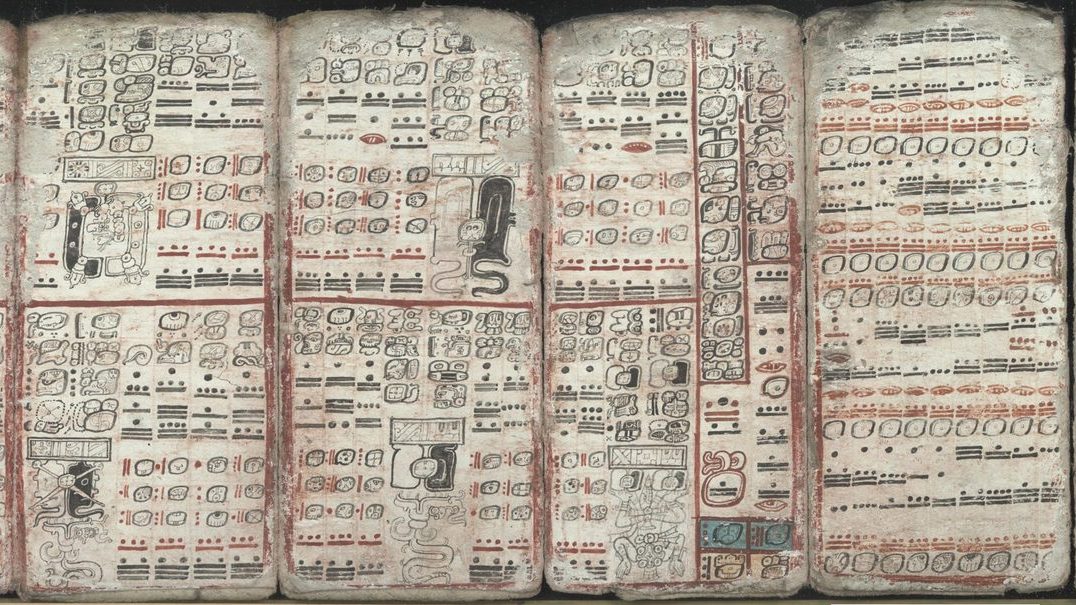
Maya epigrapher David Stuart, writing on his Maya Decipherment research blog, has pushed back on how this gets taught: the modified, zero-bearing, positional notation used in Long Count dates was restricted to time-reckoning and never carried over into the ordinary vigesimal counting reflected in spoken Mayan languages. Surviving codices like the Dresden and Madrid manuscripts record counts of goods and offerings using multiplicative and additive notation instead, grouping bar-and-dot figures against separate 20-count (winik) glyphs, not the same stacked place-value system used for dates. Textbook summaries that describe one unified 'Mayan numeral system' used everywhere, in other words, are describing the calendar's math, not necessarily the math the Maya used to count a market's worth of goods.
Checking the credit, not just the mechanics
None of this makes the Maya's own mathematics less real. Confirmed Maya inscriptions from El Palmar forward show a civilization running Long Count calculations across spans of tens of thousands of years, tracking astronomical cycles with a precision that outlasted the individual kingdoms that recorded them. What the Chiapa de Corzo and El Palmar dates change is who gets first credit for the zero itself, and by how much: not the Maya, and not by a small margin.
That kind of gap between a popular attribution and what the primary dates actually show is the same pattern behind the 'new' map projection that press coverage called revolutionary in 1973, when cartographers had already been using the same projection since 1855: a specific, checkable record undercutting a simpler story that had already taken hold.