
An acronym invented to mock the policy it names
"Mutually assured destruction" describes a state in which two nuclear powers each hold enough weapons, and enough certainty of being able to use them even after absorbing a first strike, that neither can attack the other without guaranteeing its own destruction in the retaliation that follows. The idea itself dates to the early Cold War, and U.S. Secretary of Defense Robert McNamara built it into declared American strategy through the 1960s. The catchy acronym, though, came from someone arguing against the policy.
Donald Brennan, a strategist at Herman Kahn's Hudson Institute, coined "mutually assured destruction" and its acronym MAD in 1962. Brennan favored ballistic missile defense and thought a doctrine that left both superpowers permanently vulnerable, by design, was reckless; spelling the initials out to read "mad" was a deliberate jab; he wanted the label itself to make the case that a policy built on holding civilian populations hostage to nuclear annihilation was irrational. The label stuck, but its critical origin did not survive in popular use, and MAD is now used almost universally to just name the doctrine, not condemn it.
Guaranteed retaliation, not defense
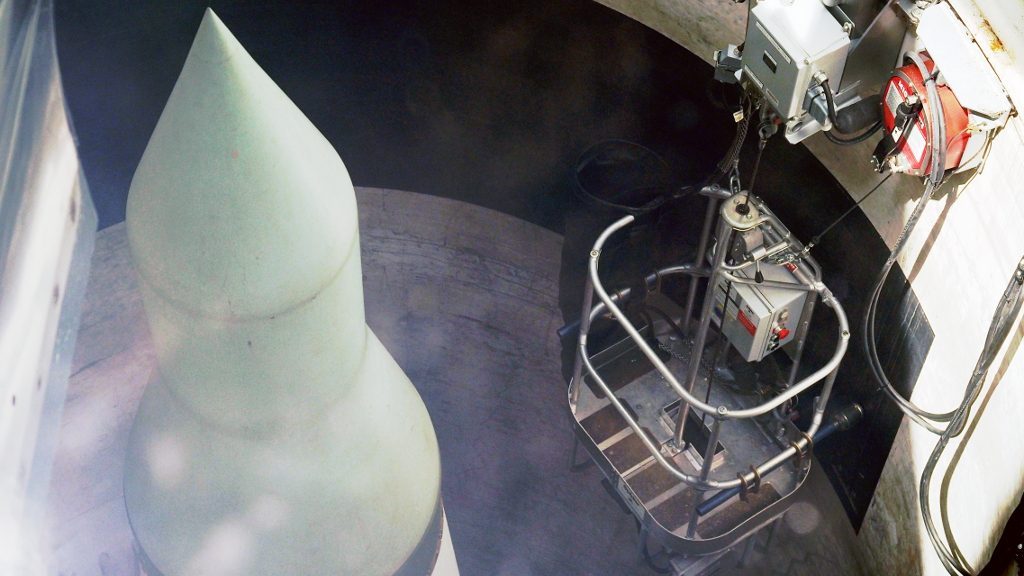
MAD rests on second-strike capability: each side needs enough weapons to survive a surprise attack and still deliver a devastating counterattack. That requirement is why both the United States and the Soviet Union built what became known as the nuclear triad, spreading weapons across land-based intercontinental ballistic missiles in hardened silos, submarine-launched missiles hidden at sea, and bombers that could scramble before impact, so that no single strike, however precise, could plausibly disarm the other side. A missile silo built to this standard, like the Delta-09 launch facility pictured above, was never meant to survive a direct hit; it was built so that enough of its sister silos elsewhere would.
The doctrine is closely tied to game theory as it developed at the RAND Corporation in the 1950s and 1960s, where analysts including Herman Kahn and Thomas Schelling modeled nuclear standoffs as a version of the game of chicken: whichever side blinks first, backing down or striking first out of panic, loses, but if neither blinks, both are destroyed. Schelling's contribution, later recognized with a share of the 2005 Nobel Memorial Prize in Economic Sciences, was to show that credibility, making the retaliation threat genuinely believable to the other side, mattered as much as the raw size of an arsenal.
1962: the submarine that came one vote from firing
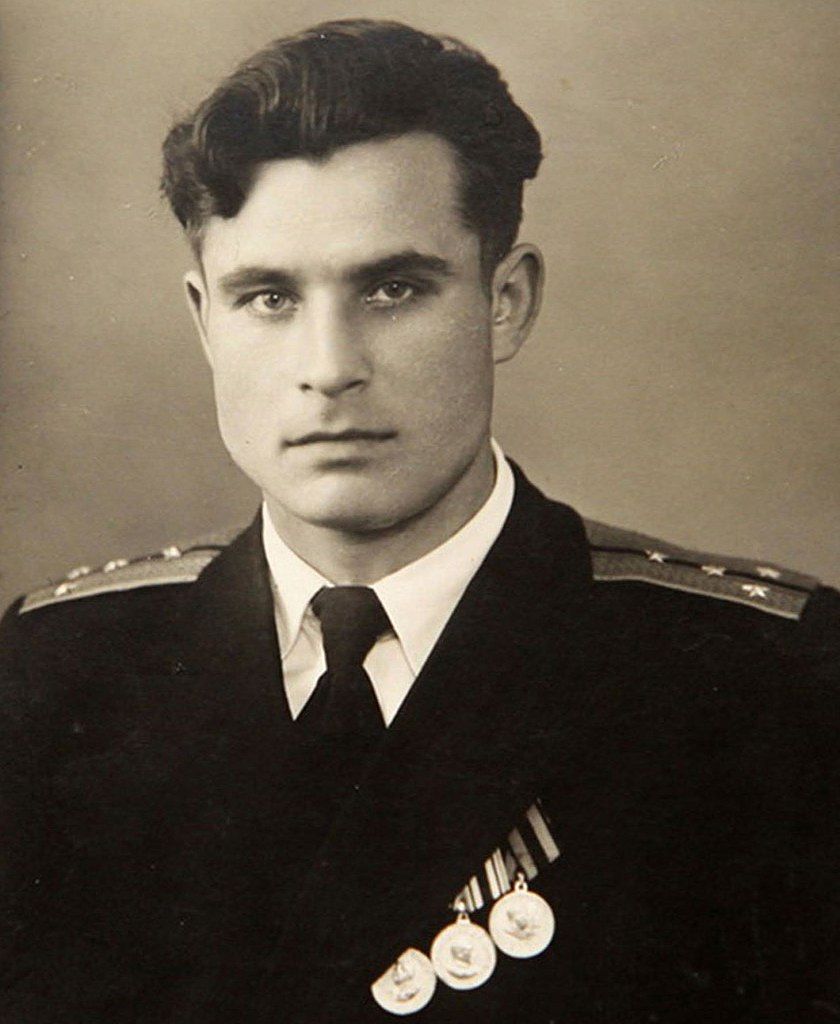
The doctrine's logic assumes rational leaders weighing survival against escalation, but its closest real test came down to one man on a submarine cut off from Moscow. On 27 October 1962, during the Cuban Missile Crisis, U.S. Navy destroyers and the carrier USS Randolph located the Soviet submarine B-59 near Cuba and began dropping practice depth charges meant to force it to surface for identification. The submarine's crew, out of radio contact for days and unaware the charges were non-lethal signaling devices rather than an attack, believed war had already started.
B-59 carried a nuclear-tipped torpedo, and Soviet protocol allowed the captain and political officer to authorize its use without contact with Moscow. Captain Valentin Savitsky, convinced they were under attack, moved to fire. But B-59 was also carrying the commander of the entire submarine flotilla, Vasili Arkhipov, whose presence meant a third officer's agreement was required. Arkhipov refused to consent and argued Savitsky into surfacing, not firing, an account corroborated by declassified Soviet naval records reviewed by George Washington University's National Security Archive in 2022. Had the torpedo launched, the near-certain U.S. retaliation would have arrived not as a calculated deterrence exchange but as a response to a decision made by a rattled crew that believed, wrongly, that the war had already begun.

1983: the satellite that reported five missiles that weren't there
Twenty-one years later, the same kind of failure nearly happened from the opposite direction. Just after midnight on 26 September 1983, the Soviet Oko satellite early-warning system reported that the United States had launched one intercontinental ballistic missile, with four more following. Lieutenant Colonel Stanislav Petrov, the engineer on duty at the command bunker that monitored Oko, had helped develop the software that analyzed the satellite data and understood its failure modes better than most officers on that shift.
A five-missile launch struck Petrov as an implausible way to open an American first strike, since doctrine on both sides assumed any real attack would come as an overwhelming, saturating salvo, not a token handful. He also had no confirmation from Soviet ground-based radar, which should have detected real incoming missiles well before Oko's system, built to flag optical launch flashes from orbit, did. Petrov chose to report the alert as a system malfunction rather than pass it up the chain toward a retaliatory launch decision. The cause, confirmed afterward, was Oko misreading sunlight reflecting off high-altitude clouds along its satellites' orbital path as missile engine plumes. Petrov's decision went unpublicized for years and only became widely known after a 1998 memoir by his former commander; he received no formal commendation at the time, and the incident was internally treated as an embarrassment to be minimized rather than a success to be rewarded.


How big the arsenals actually got
The stockpiles behind the doctrine grew far larger than the deterrence math strictly required. Declassified U.S. State Department figures put the American stockpile at its historic maximum of 31,255 warheads at the end of fiscal year 1967, a number kept classified for decades and only published in a 2021 government transparency fact sheet. The Soviet arsenal peaked later and higher, pushing the combined global stockpile to roughly 70,300 warheads in 1986, according to Federation of American Scientists estimates compiled from declassified records on both sides.
Both countries have dismantled the large majority of that peak stockpile since; FAS estimates put the global total at about 12,321 warheads at the start of 2026, still enough for both the U.S. and Russian arsenals individually to end organized civilization several times over, but a fraction of the Cold War maximum. Most of that reduction came through bilateral treaties, principally the 1991 and 1993 Strategic Arms Reduction Treaties and the 2010 New START agreement, that set verified limits both sides had to meet, not unilateral restraint alone.
Hollywood's satire versus the film that changed real policy
MAD has been dramatized on screen since near its founding, and the treatments split into two very different categories: pure satire, and the one that fed directly back into government policy. Stanley Kubrick's 1964 Dr. Strangelove played the doctrine's central absurdity for black comedy, a rogue general triggering an unstoppable Soviet doomsday device that the Soviets had built but never announced, defeating the entire point of a deterrent whose power depends on the other side knowing about it. FactCrumbs has covered this gap between blockbuster and fossil record before, and more than once: dinosaur movies invent a specific dramatic capability, a frill, a venom spit, a killing claw strike, that the real animal never had reason to use. Dr. Strangelove's doomsday device runs on the same license, an absurdist prop built to make a point about deterrence, not a documented flaw in any actual command-and-control system.
WarGames, released in June 1983, worked differently. The film, about a teenager who accidentally accesses a military supercomputer and nearly triggers a real nuclear launch sequence while believing he is playing a game, unsettled President Ronald Reagan enough that he raised it directly with Chairman of the Joint Chiefs of Staff General John Vessey a few days after watching it at Camp David, asking, according to journalist Fred Kaplan's book Dark Territory, "could something like this really happen? Could someone break into our most sensitive computers?" Vessey's staff reported back a week later that the real vulnerabilities were worse than the film depicted. In 1984, Reagan signed National Security Decision Directive 145, one of the first presidential directives to treat computer security as a national security matter, a policy shift traced directly back to a summer blockbuster rather than to a classified threat assessment.
Where the doctrine stands in 2026
The framework of verified limits that followed the Cold War arms race lapsed in early 2026. New START, the last treaty setting binding caps on U.S. and Russian strategic nuclear forces, expired on 5 February 2026 after Washington did not respond to a Russian offer to keep observing its central limits informally. According to the Arms Control Association, this is the first time since the early 1970s that the two countries' strategic arsenals have gone unconstrained by any legally binding agreement, with no successor treaty under negotiation.
Against that backdrop, the Bulletin of the Atomic Scientists set its Doomsday Clock, the symbolic measure the organization has published since 1947, at 85 seconds to midnight on 27 January 2026, four seconds closer than the 89-second setting a year earlier and the closest the clock has ever stood in its history. The board cited expiring nuclear treaties alongside climate change and AI-driven disinformation as the drivers. The doctrine that Donald Brennan named as an insult in 1962 is, by that measure, currently operating with less formal restraint on the weapons it governs than at any point since before the first arms control treaties existed.