.jpg)
How scientists actually measured the bite force
You can't strap a bite-force sensor onto a living T. rex, so in 2017 Florida State University's Gregory Erickson and Oklahoma State University's Paul Gignac built their estimate a different way: they started with living crocodiles, lassoing individual animals and getting them to bite down on a modified scale to measure real bite force directly. From there, they used what's known about crocodilian jaw muscle architecture to build a detailed 3D computer model scaled up to T. rex's skull.
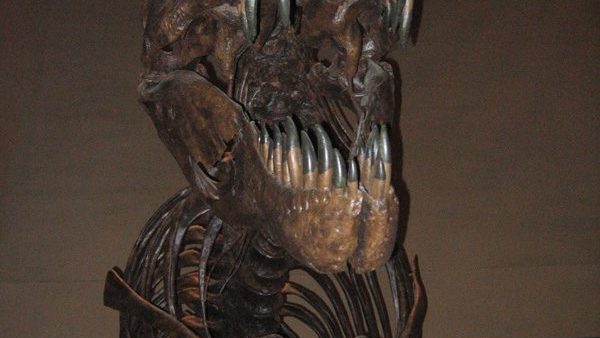
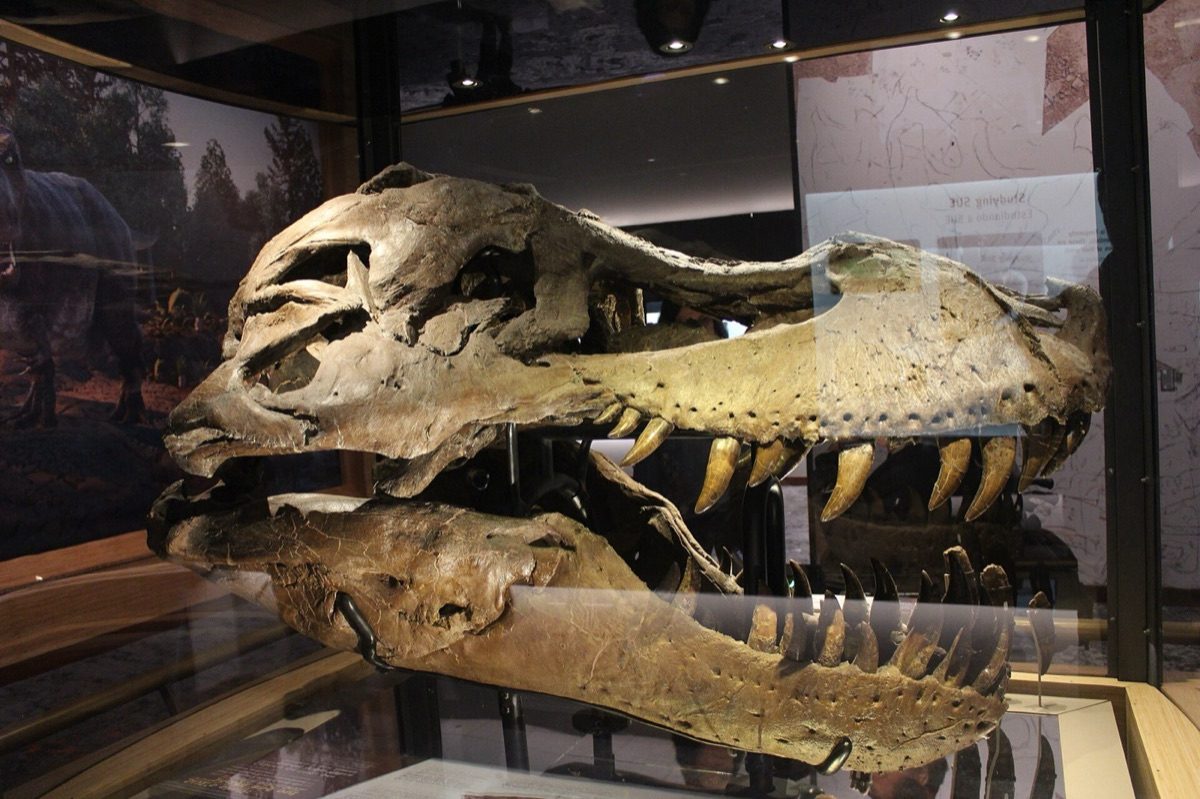
The result, published in Scientific Reports, put T. rex's bite at roughly 8,000 pounds of force (about 34,522 newtons at the back teeth), more than double the bite of the largest crocodiles alive today. Erickson described the scale of it plainly in an interview with NPR: "What we came up with were bite forces of around 8,000 pounds. That's like setting three small cars on top of the jaws of a T. rex, that's basically what was pushing down." The long, conical teeth concentrated that force into an estimated 431,000 pounds per square inch of pressure at the tooth tip, enough to crush bone rather than just cut through flesh, a feeding style researchers call extreme osteophagy.

Predator or scavenger? The debate that mostly wasn't one
This is the part where the popular story and the scientific record come apart. Jack Horner argued that T. rex was primarily a scavenger, pointing to its keen sense of smell (useful for finding carcasses from a distance), its bone-crushing jaw shape (more useful for cracking open scavenged remains than for a clean kill), and the risk a 40-foot animal ran by sprinting after live prey. He made the case in talks, popular books, and documentaries, and in a 1994 conference-proceedings piece with the memorable title "Steak Knives, Beady Eyes, and Tiny Little Arms." What he never did was publish it in the peer-reviewed literature, and he has said as much himself. In his 1993 book he wrote that he was not actually convinced T. rex only scavenged, and sometimes said so just to get colleagues arguing.
Other paleontologists objected from the start, and by 2008 Thomas Holtz had gone through the anatomical arguments (the small eyes, the speed, the skull, the arms) one at a time and found none of them supported obligate scavenging. Writing in National Geographic in 2013, Brian Switek called the whole thing a twenty-year non-debate that journalists and documentary programs kept alive long after the field had moved on.
The fossil most often credited with ending the argument is a 2013 find: a broken T. rex tooth crown embedded between two tail vertebrae of a hadrosaur (a duck-billed plant-eater), with new bone growth around it, meaning the wound had begun healing. That only happens if the animal survives the bite. A T. rex had attacked a living hadrosaur, missed a killing blow, and the hadrosaur got away and lived long enough afterward for the bone to start repairing itself. It's a clean specimen, but it wasn't the first of its kind. Kenneth Carpenter had described healed tyrannosaur bite damage on an Edmontosaurus tail back in 1998. The working consensus, before and after both finds, is the unglamorous one: an active predator that, like most living predators, wouldn't turn down a free meal either.
Did it actually have feathers?
This one is genuinely unsettled, and the honest answer is more interesting than a flat yes or no. A 2017 study in Biology Letters examined skin impressions from the neck, pelvis, and tail of multiple adult T. rex specimens, comparing them against skin patches from related tyrannosaurs like Albertosaurus and Gorgosaurus. The finding: scaly skin in every one of those examined regions, with no feather impressions turning up in any of them.
That doesn't fully settle the juvenile question, though, and it doesn't rule out feathers on parts of the adult body that haven't been found as fossil impressions yet either. Hatchling and young T. rex weighed only a few kilograms, small enough to face the same heat-loss problem that smaller feathered theropods dealt with, which makes an insulating juvenile coat biologically plausible. But no well-preserved juvenile T. rex skin has ever been found, so that idea remains an informed guess rather than a confirmed fact. The scaly-adult finding, for the body regions actually examined, is solid; the feathered-juvenile idea is a reasonable hypothesis waiting on fossil evidence that may never turn up. None of this makes T. rex a flier of any kind, and the genuinely airborne reptiles of its era weren't dinosaurs either: they were pterosaurs, a separate group with its own real names, Pteranodon and Hatzegopteryx among them.
The timeline that breaks most people's intuition
Popular culture tends to lump "dinosaurs" into one blurry era, which makes this fact land harder than it should: Stegosaurus lived in the late Jurassic period, roughly 150 million years ago. T. rex showed up in the late Cretaceous, around 66 to 68 million years ago. That's an 83-million-year gap between the two, according to Smithsonian Magazine's rundown of the timeline.
Compare that to the roughly 66 million years separating T. rex's extinction from today. T. rex is closer in time to you reading this than it was to Stegosaurus. If Stegosaurus could have watched T. rex evolve, T. rex would have seen Stegosaurus the way we see it now: as an impossibly ancient relic from a different age entirely. Not every ancient lineage disappeared the way T. rex did, though: a living fossil is the term for a species still alive today that looks almost unchanged from ancestors tens or hundreds of millions of years old, cases like the coelacanth that make this dinosaur's total, 66-million-year absence look all the more complete by comparison. Other duck-billed dinosaurs had already come and gone by the time T. rex showed up: the hollow-crested hadrosaurid Parasaurolophus lived in western North America roughly 76.5 to 73 million years ago, several million years before Tyrannosaurus rex itself appears in the fossil record.
How long it actually took a T. rex to grow up
For years, the working estimate was that T. rex hit full size somewhere around age 25, based on growth rings counted in cross-sections of leg bone. A January 2026 study in PeerJ, led by Oklahoma State University anatomist Holly Woodward alongside Nathan Myhrvold and John Horner, pushed that number much further out. Cutting thin sections from the femurs and tibiae of 17 individuals, from small juveniles to full adults, the largest such dataset ever assembled for the species, and examining the slices under circularly polarized and cross-polarized light, the team found growth rings that standard light microscopy had been missing entirely. Counting those previously hidden rings, along with a new statistical model, put T. rex's growth curve at roughly 40 years to reach its full adult size of around eight tons, considerably longer than earlier estimates assumed.
That extra detail did something else, too: it exposed two specimens that don't fit the curve. The growth trajectories of two well-known individuals nicknamed Jane and Petey, long treated as juvenile or subadult T. rex in museum displays, turned out statistically incompatible with the growth pattern every other specimen in the study followed, an anomaly serious enough that the Woodward team flagged it as needing its own explanation.
Jane and Petey may not be T. rex at all
That explanation arrived from a different research group entirely. In an October 2025 paper in Nature, North Carolina State University paleontologists Lindsay Zanno and James Napoli compared more than 200 tyrannosauroid fossils, including the long-debated "Dueling Dinosaurs" specimen, and concluded that Jane and Petey-type animals aren't young T. rex growing up at all. Their analysis found consistent, adult-level differences from T. rex in forelimb and hand proportions, claw shape, skull nerve and sinus anatomy, and tail vertebra count, differences that don't track with simple age, and used them to confirm a smaller tyrannosaur genus called Nanotyrannus as its own valid lineage rather than a juvenile stage of Tyrannosaurus.
Zanno and Napoli went further and split that genus in two: the Dueling Dinosaurs predator was assigned to Nanotyrannus lancensis, a species name that had existed since 1988 but lacked this kind of confirming evidence, while the Jane specimen, distinguished by its own sinus pattern and a differently shaped bone behind the eye, was named a brand-new second species, Nanotyrannus lethaeus. The two papers arrived from separate teams using separate methods within months of each other and reached compatible conclusions from different directions, Woodward's bone histology flagging Jane and Petey as statistical outliers, Zanno and Napoli's comparative anatomy explaining why: a debate that split paleontologists for decades over whether Nanotyrannus was a real animal or just a young T. rex looks, for now, largely settled in Nanotyrannus's favor. Mistaken identity in the fossil record runs in more than one direction: Arsinoitherium's uncanny resemblance to a rhinoceros is just as deceptive, despite the animal belonging to its own extinct order with no real relation to rhinos at all. FactCrumbs's other prehistoric write-ups, on animals like Spinosaurus and the saber-tooth tiger, sit in the Prehistoric Life topic hub.