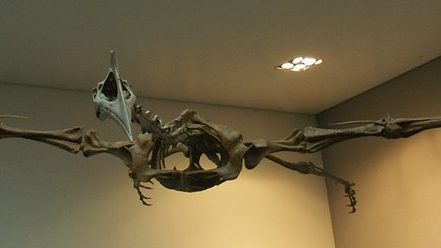

"Pterodactyl" is really just one genus name, stretched
Pterodactylus was one of the first pterosaurs ever named and described, back in the early 1800s, and the popularized nickname "pterodactyl" stuck to the public imagination long after paleontology moved on. The formal break came in 1834, when Johann Jakob Kaup named the order that became Pterosauria, and Britannica dates the demotion of "pterodactyl" to an informal label from roughly that point. It never stopped being the word most people reach for.
The umbrella term paleontologists actually use is "pterosaur," which covers the entire order of flying reptiles, more than 150 known species ranging from the size of a sparrow to the size of a small airplane. Pterodactylus itself was a relatively small, unremarkable member of that much larger group.
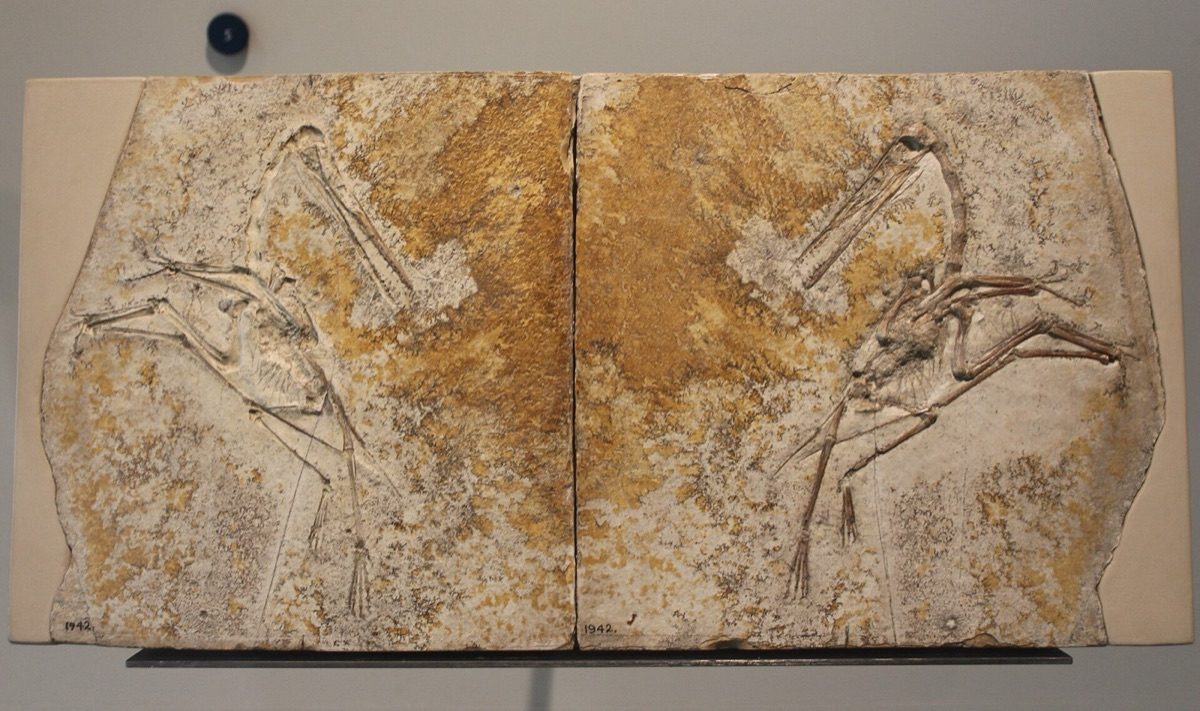

The bigger misconception: they weren't dinosaurs
This is the one that catches most people off guard. Pterosaurs are reptiles, and they lived alongside dinosaurs, but they were not dinosaurs. The Natural History Museum of Utah draws the line anatomically rather than by family resemblance: dinosaurs have a hole in their hip socket, where a pterosaur's hip socket is a bony depression, and the semi-circular canals of the inner ear are short and wide in dinosaurs but thin, tall and hoop-like in pterosaurs. Its summary of the descent is blunt: dinosaurs, meaning ornithischians and saurischians, evolved from a common ancestor that pterosaurs do not share.
Pterosaurs are also not the only animal that gets filed under "dinosaur" by mistake. The giant marine lizard Mosasaurus has exactly the same problem from the other direction: it lived underwater, not in the air. The same kind of mistaken identity shows up away from the water and sky entirely: Arsinoitherium, a horned mammal mistaken for a rhinoceros, belongs to its own extinct order with no real kinship to rhinos at all.
The confusion largely comes from pop culture. Movies and documentaries routinely show pterosaurs soaring over scenes built around crowd-pleasers like Tyrannosaurus rex and the feathered, turkey-sized real Velociraptor, which trains people to mentally file them all under the same category. What separates the two groups is ancestry, not posture. The formal definition of a dinosaur is drawn around a common ancestor and all its descendants, with that hip socket serving as the practical anatomical tell. Pterosaurs sit on the neighbouring branch: the two lineages split from one shared ancestor and went their own ways, so neither group is a kind of the other. Cats and dogs are the closer comparison, two lineages off a single common ancestor, similar enough to blur together at a glance, but with neither one sitting inside the other.
The biggest one: Quetzalcoatlus, and how big it actually was
The largest pterosaur, and the largest flying animal known to have ever existed, was Quetzalcoatlus. A comprehensive 2021 study of the fossils, housed at the University of Texas at Austin's Vertebrate Paleontology Collections and published as a five-paper monograph in the Journal of Vertebrate Paleontology, reconstructed the largest species, Quetzalcoatlus northropi, at a wingspan of almost exactly 10 meters (about 33 feet). Which number you meet depends on where you read it: UT Austin's own press release rounds the same result up to a wingspan "nearing 40 feet," and the Natural History Museum's writeup of that work gives around 11 metres. Even at the low end of that range it is roughly the wingspan of a small private plane. The same monograph formally named a second, smaller species in the same genus, Quetzalcoatlus lawsoni, with reconstructions in the technical literature putting its wingspan at roughly 15 to 20 feet (4.5 to 6 meters) depending on whether you use the press-release figure or the peer-reviewed reconstruction, still large by any ordinary standard but a genuinely different animal from its giant relative.
That 2021 project was the first genuinely comprehensive study of the animal's anatomy, not just another estimate. As Matthew Brown, director of the Vertebrate Paleontology Collections, put it in UT Austin's own announcement of the findings: "This is the first time that we have had any kind of comprehensive study." Kevin Padian, an emeritus professor at UC Berkeley and co-editor of the research, added a detail that explains why something this size could fly at all: "Pterosaurs have huge breastbones, which is where the flight muscles attach, so there is no doubt that they were terrific flyers."
Where the name actually comes from
The fossils were found in 1971 by Douglas Lawson, then a 22-year-old geology graduate student, while investigating a dry riverbed at Big Bend National Park in Texas; he worked the material up with Wann Langston Jr. of the University of Texas at Austin. Lawson turned up a roughly 3-foot bone with the hollow, thin-walled structure characteristic of pterosaur skeletons, evidence built for flight rather than for the kind of load-bearing bulk seen in dinosaur bones of similar size.
When Lawson formally named the animal in 1975, he gave it a name with two meanings folded into one. "Quetzalcoatlus" honors Quetzalcoatl, the feathered serpent god of Aztec mythology, and the species name "northropi" nods to John Knudsen Northrop, founder of the Northrop aviation company, a nod to the animal's status as an aircraft-sized flier before anyone had proven it could actually fly one. At the time of the 1975 announcement, it was already recognized as the largest flying creature known to have existed, a title the 2021 monograph's more detailed anatomical work has only reinforced, not overturned.
How it actually got airborne
For decades, paleontologists genuinely debated whether something the size of Quetzalcoatlus could fly at all, or whether it was simply too heavy to get off the ground. The 2021 analysis worked out the answer: it couldn't just flap its way up from a standstill. It needed a running or standing jump of at least 8 feet (about 2.5 meters) into the air first, using powerful leg muscles to launch, then converted that initial height into a climb with its wings.
Once airborne, it likely behaved something like a giant heron: wading through shallow water or walking open ground to hunt, plucking prey, then launching skyward again rather than staying aloft continuously. How far it could go once up is genuinely unsettled. A widely repeated figure, originating in a 2010 conference presentation by Michael Habib and never published as a peer-reviewed paper, puts it at as much as 640 kilometers (400 miles) in a day at speeds approaching 130 km/h (80 mph). The only peer-reviewed attempt to model the question since, Goto and colleagues in PNAS Nexus in 2022, reached the opposite conclusion: they found Quetzalcoatlus soared poorly, compared it to a bustard or ground hornbill, and wrote that earlier studies "overstated the flight ability of large azhdarchid pterosaurs." No peer-reviewed rebuttal to that paper had appeared in the literature as of 2026, so the long-range figures are best read as an unproven hypothesis, not an established fact.