.jpg)
One hunting strategy, built independently by at least twelve spider families
A trapdoor spider is not a single species or even a single family; it is a hunting strategy that kept getting reinvented. Wikipedia's index of the group lists eleven separate families within the infraorder Mygalomorphae that independently build the same basic structure: Actinopodidae (the "mouse-spiders" of South America and Australia), Antrodiaetidae (the "folding trapdoor spiders" of the United States and Japan), Ctenizidae and the related Halonoproctidae ("cork-lid" spiders), Cyrtaucheniidae and Euctenizidae ("wafer-lid" spiders), Idiopidae ("spurred" or "armoured" trapdoors, concentrated in the Southern Hemisphere), Migidae ("tree trapdoor spiders"), Nemesiidae ("tube trapdoor spiders"), and a scattering of species inside Theraphosidae, the tarantula family. A twelfth family, Liphistiidae, builds trapdoors too, but sits in an entirely separate suborder, Mesothelae, spiders with a segmented abdomen whose lineage split from every other living spider roughly 300 million years ago.
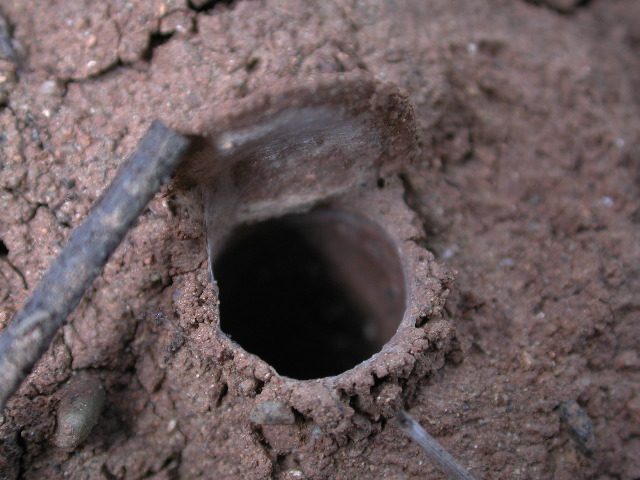
What unites them is the burrow, not the ancestry: a silk-lined tunnel sealed with a hinged lid, camouflaged with soil, moss or leaf litter, that the spider holds shut from below and pops open in an instant to grab passing prey. The lid comes in two basic designs: a thick, beveled "cork" door that plugs the opening almost like a stopper, or a thinner "wafer" door that lies flatter against the surrounding ground. Either way, the spider never leaves home to hunt. It wires the burrow's rim with silk or twig "triplines" radiating out across the nearby ground; according to the Australian Museum, when an insect trips one, the spider feels the vibration through its legs and leaps out from under the door.
A door built to out-hold a small jet, aimed at the animal that actually threatens it
The trapdoor's strength has been measured directly. Guinness World Records credits the California trapdoor spider, Bothriocyrtum californicum, with the title of world's strongest spider, after tests found it could resist a pull of 38 times its own body weight while bracing the door shut with its fangs, claws and legs from inside the burrow. Guinness frames the comparison this way: an average 82-kilogram man trying to hold a door closed against a force 38 times his own weight would be resisting something close to the pull of a small jet, for scale, elite Olympic powerlifters can only lift about three times their own bodyweight.
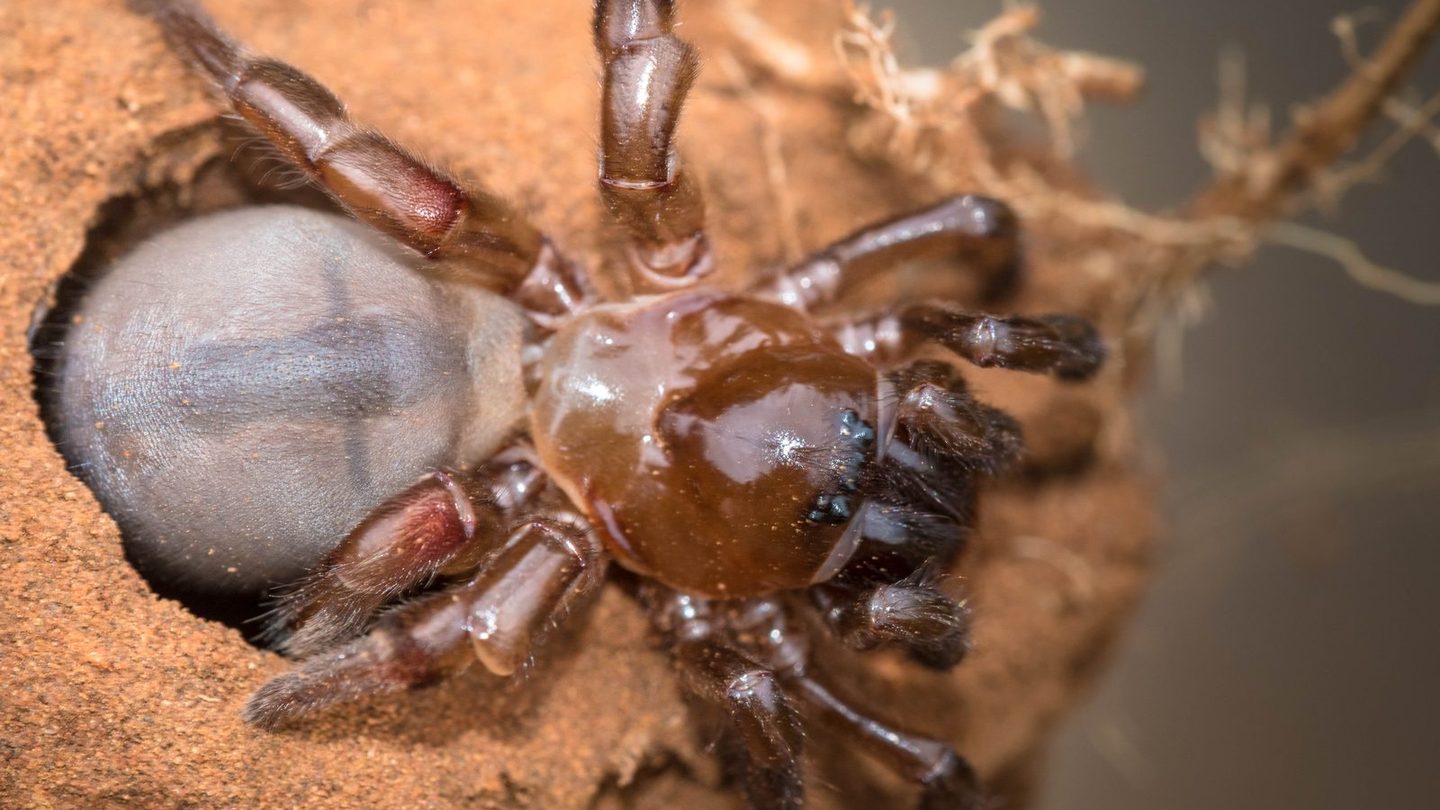
That kind of force exists for a reason, and it isn't people. Parasitoid wasps are among the trapdoor spider's most persistent threats, capable of forcing or piercing a burrow's silk-plugged door to lay an egg on the spider inside. Some lineages have evolved a second defense behind the door itself: species in the genus Cyclocosmia, in the family Halonoproctidae, have a hardened, abruptly truncated abdomen that the spider can use to physically plug the burrow from below if a predator gets past the lid, a trait Singaporean macro photographer Nicky Bay described when he documented a captive specimen in 2019, writing that it "prevents any effective attacks from predators such as wasps." Those same photos went viral on Facebook in 2021 with a caption claiming the spider's "sting" could kill a person within five minutes; AFP Fact Check debunked the claim after UC Davis arachnologist Jason Bond confirmed Cyclocosmia has no known toxicity to humans, telling reporters his lab has worked with the species for years without incident. Trapdoor spider venom generally targets insect nervous systems and is not considered medically significant in a bite to a person, a sharp contrast with the genuinely dangerous neurotoxin behind a black widow's bite. Other burrow-dwelling arachnids solve the predator problem without a door at all: a vinegaroon's defense is a precisely aimed spray of concentrated acetic acid fired from the base of its tail, a purely chemical answer with no hideout involved at all.
.jpg)
Hunting entirely by touch
None of the trapdoor-building families spin an aerial web the way an orb-weaver spider does: a trapdoor spider's silk stays inside the burrow or radiates out as a few ground-level trip-lines, so the ambush strike depends on vibration rather than sight. A 2022 study in Invertebrate Biology by Nakamura, Mukai and Tokuda tested that directly on Latouchia typica, a trapdoor spider in the same family as Cyclocosmia, using nymphs of the speckled cockroach Nauphoeta cinerea as prey. Spiders with their eyes painted over still captured prey at a high rate, showing vision plays little to no role in the strike, while laying a rubber mat over the ground to dampen substrate vibrations sharply cut capture success regardless of whether the spider could see, the first experiment to demonstrate directly that ground vibration, not sight, triggers a trapdoor spider's strike.
That reliance on touch over sight is one solution among several for an ambush hunter that never learned to build a snare. Wolf spiders solve the same basic problem by running their prey down in the open instead of waiting behind a door, relying on eyesight and speed rather than vibration; a trapdoor spider gave up mobility for concealment and built its sensory system entirely around detecting movement it cannot see coming. The trip-lines themselves, threads of silk or twig fragments woven into the rim of the burrow, are the mechanism the Australian Museum documents: prey stepping on one produces a vibration the spider's legs pick up through the burrow wall, triggering the door to fling open in well under a second. Pincers do real damage elsewhere in the arachnid world, too, just on a much smaller animal: pseudoscorpions carry venom in their claws, and researchers have only started working out its chemistry since 2018.
Forty-three years in one burrow, then a wasp
The same ambush-and-wait strategy that leaves trapdoor spiders vulnerable to parasitoid wasps also appears to be part of what lets some of them live for decades. In March 1974, Australian arachnologist Barbara York Main began a long-term population study of trapdoor spiders near Tammin, in Western Australia's wheatbelt. Among the spiderlings she found and marked that year, freshly dispersed from their mother's burrows after the season's first autumn rain, was one cataloged as Number 16, a female Gaius villosus in the family Idiopidae who had likely hatched a year or more earlier, in late 1972 or early 1973, and spent that time still sheltering underground before striking out on her own. Main returned to the site annually, sometimes more often, for more than four decades, tracking Number 16's burrow the entire time.
Number 16 was still alive during a survey roughly six months earlier, but on 31 October 2016, research assistant Leanda Mason found her burrow's silk-plugged door in disrepair and the spider gone; the evidence pointed to a parasitic wasp that had pierced the door to get at her. A 2018 paper in Pacific Conservation Biology by Leanda Mason, Grant Wardell-Johnson and Barbara York Main concluded, based on the species' burrow fidelity, that Number 16 was roughly 43 years old at death, making her the longest-lived spider on record and beating a 28-year-old tarantula that had previously held the title. Most trapdoor spiders live five to twenty years; researchers involved in the study attributed the extraordinary run to traits shared across the wider family, living in undisturbed native bushland, staying put in one spot instead of roaming, and keeping a low metabolism — general traits of the family, not something specific to Number 16 alone.
New species are still being described, and some are already endangered
Trapdoor spider taxonomy is far from finished. In 2023, Michael Rix, Jeremy Wilson and Paul Oliver described Euoplos dignitas, a new species of giant trapdoor spider, in the Journal of Arachnology, based on specimens collected from the Brigalow Belt of inland Queensland. It belongs to Idiopidae, the same family as Number 16, specifically to the tribe Euoplini, a lineage researchers describe as among the most diverse groups of mygalomorph spiders in subtropical eastern Australia. Females of the new species grow to about 5 centimeters and can live more than 20 years in the wild; males, smaller at up to 3 centimeters, leave the burrow only once mature, to search for a mate.
The species is already a conservation concern. Euoplos dignitas is known from just a few locations around the rural towns of Eidsvold and Monto, where it burrows into the black soils of open transitional woodland, and the researchers' assessment found that much of that habitat has already been lost to land clearing, likely making the species Endangered soon after its own description. For an animal whose entire strategy is staying hidden behind a disguised door, being found by science turned out to be the first step toward being formally recognized as at risk.