_(Great_Stirrup_Cay,_Bahamas)_(16144990625).jpg)
It isn't a vegetable, and it breathes through its anus
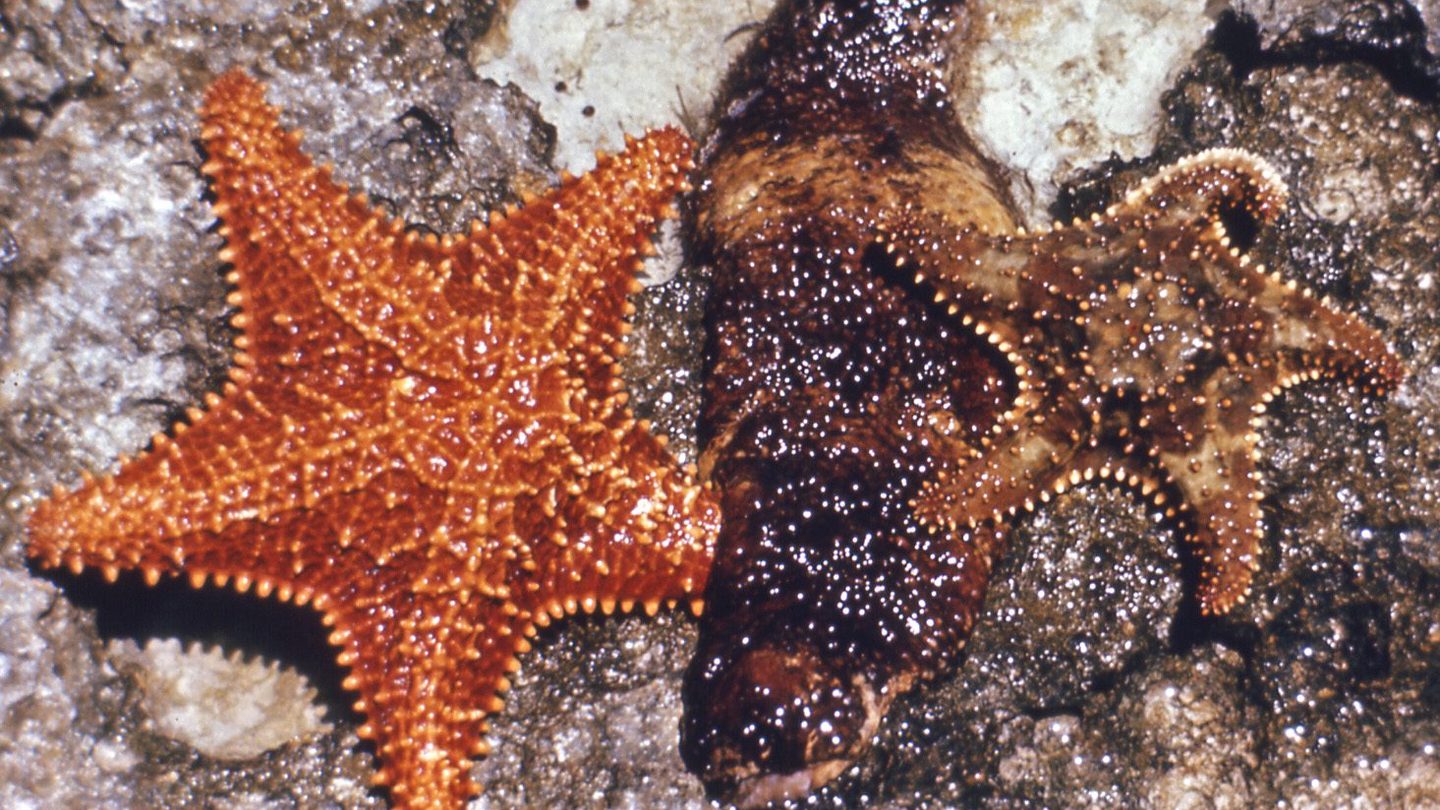
A sea cucumber is not a plant, a shell, or a slug, despite regularly getting lumped in with all three by people who have never seen one described accurately. It's an echinoderm, in the class Holothuroidea, the same phylum as sea urchins and sea stars, with roughly 1,250 known species living on or near the seafloor in every ocean on Earth, from shallow tide pools to trenches deeper than 5,000 meters. Unlike its urchin and sand-dollar relatives, which build a rigid, fused-plate skeleton called a test, a sea cucumber's skeleton is reduced to microscopic calcareous ossicles, typically 10 micrometers to 1 millimeter long, scattered through a soft, muscular, leathery body wall instead of forming a shell. That soft-bodied design is also why it has no equivalent of Aristotle's lantern, the five-part grinding jaw that lets sea urchins and sand dollars scrape and crush food; a sea cucumber instead sweeps sediment or suspended particles into its mouth with a ring of branched, mucus-coated oral tentacles and digests the organic material off whatever it swallows. A completely different mollusk shows what that same toughness arms race can produce in a feeding structure instead of a defense: a 2015 study put limpet tooth strength at 6.5 gigapascals, rivaling Kevlar and beating spider silk outright.
The stranger design choice is how it breathes. A sea cucumber's cloaca, the same rear opening it uses to void waste, connects internally to a pair of branching, tree-shaped organs called respiratory trees. The animal pumps seawater in and out through the cloaca to fill these trees, and their capillary-rich branches handle essentially all of the gas exchange the animal needs, extracting dissolved oxygen from the water and releasing carbon dioxide back into it. Research on breeding sea cucumbers published in Frontiers in Physiology found the animals can adjust breathing frequency substantially to meet higher oxygen demand during reproduction, evidence that the respiratory tree does real physiological work rather than sitting as a vestigial curiosity. Cloacal respiration of this kind is essentially unique to holothurians among echinoderms, and it is the literal, unembellished answer to why a sea cucumber breathes through what looks, to any observer, like its anus.
When something bites it, it fires its own organs at the attacker
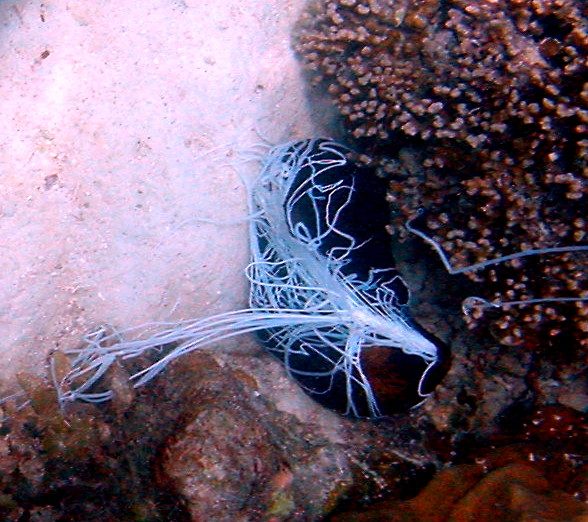
That same rear opening is also the launch point for the animal's primary defense. In several genera, most thoroughly documented in Holothuria, Bohadschia, and Pearsonothuria species, a threatened sea cucumber directs its posterior toward the attacker and contracts its body sharply enough to tear the cloacal wall, expelling a cluster of thin, whitish tissue tubes called Cuvierian tubules that sit coiled beside the base of the respiratory tree. In a 1987 morphofunctional study of Holothuria forskali published in Marine Biology, Belgian researchers Didier VandenSpiegel and Michel Jangoux found that once expelled, the tubules take on seawater forced in from the respiratory tree and elongate to as much as 20 times their resting length within seconds, while their outer layer ruptures to release a spherulocyte-derived coating that turns instantly and durably sticky on contact. A crab or fish that brushes against the tubules gets entangled in what functions as an animal-generated net, giving the sea cucumber time to move away while the predator is occupied working itself free.
Losing the tubules is not permanent. VandenSpiegel, Jangoux, and Philippe Flammang tracked regeneration in Holothuria forskali through the tissue's three cell layers in a follow-up study published in The Biological Bulletin, finding the process runs through dedifferentiation, proliferation, and redifferentiation stages and describing Cuvierian tubules as an almost inexhaustible line of defense that the animal can regrow and deploy again at relatively low energy cost. In species that go further and eviscerate part of the gut along with the tubules, the digestive tract itself regrows: a review of holothurian intestinal regeneration research found the timeline varies by species, with Holothuria glaberrima's intestine returning to its original shape after roughly a month and Apostichopus japonicus recovering digestive function within about 15 days and reaching a normal physiological state by 45 days. The organs a sea cucumber throws at a predator, in other words, are ones it is fully equipped to rebuild.

Its digestion is quietly buffering coral reefs against acidification
Sea cucumbers feed by swallowing mouthfuls of sand and sediment and digesting the organic film coating each grain, the same basic feeding strategy sand dollars use with a very different jaw, then excreting the processed mineral fraction as fine, clean castings. That gut passage does more than clean the sand: a 2011 study in the Journal of Geophysical Research: Biogeosciences by Kenneth Schneider, Jacob Silverman, Erika Woolsey, Hampus Eriksson, Maria Byrne, and Ken Caldeira, working at Australia's One Tree Reef, found that digestive acids in the sea cucumber gut dissolve a portion of the calcium carbonate minerals in the ingested sand, and the researchers calculated that this process accounts for roughly half of the reef's total measured nighttime increase in dissolved calcium carbonate.
That extra dissolved calcium carbonate adds alkalinity to the surrounding seawater, which the study's authors describe as a mechanism that can locally buffer the drop in pH driven by rising atmospheric carbon dioxide, partially offsetting one of the ways ocean acidification interferes with coral growth. The researchers also flagged the flip side: as reef growth slows under continuing acidification, the relative contribution of sea cucumber digestion to the reef's calcium carbonate budget is expected to become more significant, not less, which puts direct pressure on population-level sea cucumber declines from harvesting, discussed below, as more than a fisheries problem.
That same value made it one of the most heavily trafficked marine animals
Sea cucumbers, dried, boiled, and salted into a product long traded across Asia as bêche-de-mer, have commanded high prices in Chinese markets for centuries, and demand growth since the 1980s has pushed harvesting well past what wild populations can sustain in many regions, driving an illegal trade that now spans multiple continents. A 2022 study published in the Beche-de-mer Information Bulletin by Teale Phelps Bondaroff, Meredith Gore, and colleagues, compiling media-reported incidents of Mexican sea cucumber crime from 2011 to 2021, documented 97 separate incidents that produced 125 arrests, with Mexican and United States authorities seizing a combined 100.6 tonnes of trafficked sea cucumber valued at an estimated $29.5 million.
Australia has its own, more recently escalating version of the same problem. According to reporting by Mongabay, Australian authorities intercepted 112 foreign fishing vessels carrying a combined 22 metric tons of illegally harvested sea cucumber in the Rowley Shoals, a protected reef atoll off Western Australia where sea cucumber harvesting is prohibited entirely, between 2021 and 2023. The Australian government responded by standing up Operation LUNAR, a multi-agency task force in the Northern Territory, on December 8, 2024; per the Australian Border Force's own reporting, the operation intercepted 12 foreign fishing vessels and seized more than six tonnes of sea cucumber, 500 kilograms of other catch, and over two tonnes of preservation salt in its first 30 days alone, with the crews detained primarily Indonesian nationals. It is the same underlying pattern seen elsewhere in the intertidal zone, where a slow-moving, soft-bodied animal with no bite and no shell, like the nudibranch that survives instead on stolen chemical weapons, turns out to be under far more pressure from people than from any predator it evolved to fend off.