
A cantilever builds outward with nothing underneath it
Most bridge types need something continuous supporting them from below while they're under construction. An arch needs falsework holding its stones or ribs in place until the keystone locks the curve; a suspension bridge needs its cables strung and anchored before deck panels can hang from them. A cantilever bridge doesn't need either. Each pier carries two rigid arms projecting in opposite directions: an anchor arm tied down to the shore or an abutment behind it, and a cantilever arm reaching out toward the middle of the river with nothing beneath its far end. Where two cantilever arms from neighboring piers don't quite meet, a separate suspended span drops in between them, resting on both, as the mechanism is broken down by engineering-hardware supplier Firgelli Auto. Because every arm supports itself as it's built, crews can extend a cantilever bridge outward piece by piece over open water or a gorge with nothing temporary holding it up from below, which is exactly the kind of site where a bridge is hardest to build any other way.
The physics that lets an unsupported arm hold anything at all comes down to leverage rather than a continuous compressive arc. As the load-distribution mechanics are described by ScienceDirect's engineering reference, a cantilever carries whatever crosses it back to its own support as a bending moment, the way a loaded seesaw only stays level if the anchored end has enough counterweight to match it. That's a different logic from an arch, whose curve keeps every stone squeezed together in continuous compression and never asks the material to resist being pulled apart; a cantilever arm, by contrast, is engineered to take tension and compression at once along its own length, holding that combination without an arch's unbroken curve or a suspension bridge's cables to lean on.
Two chairs, a pile of bricks, and a man in the middle
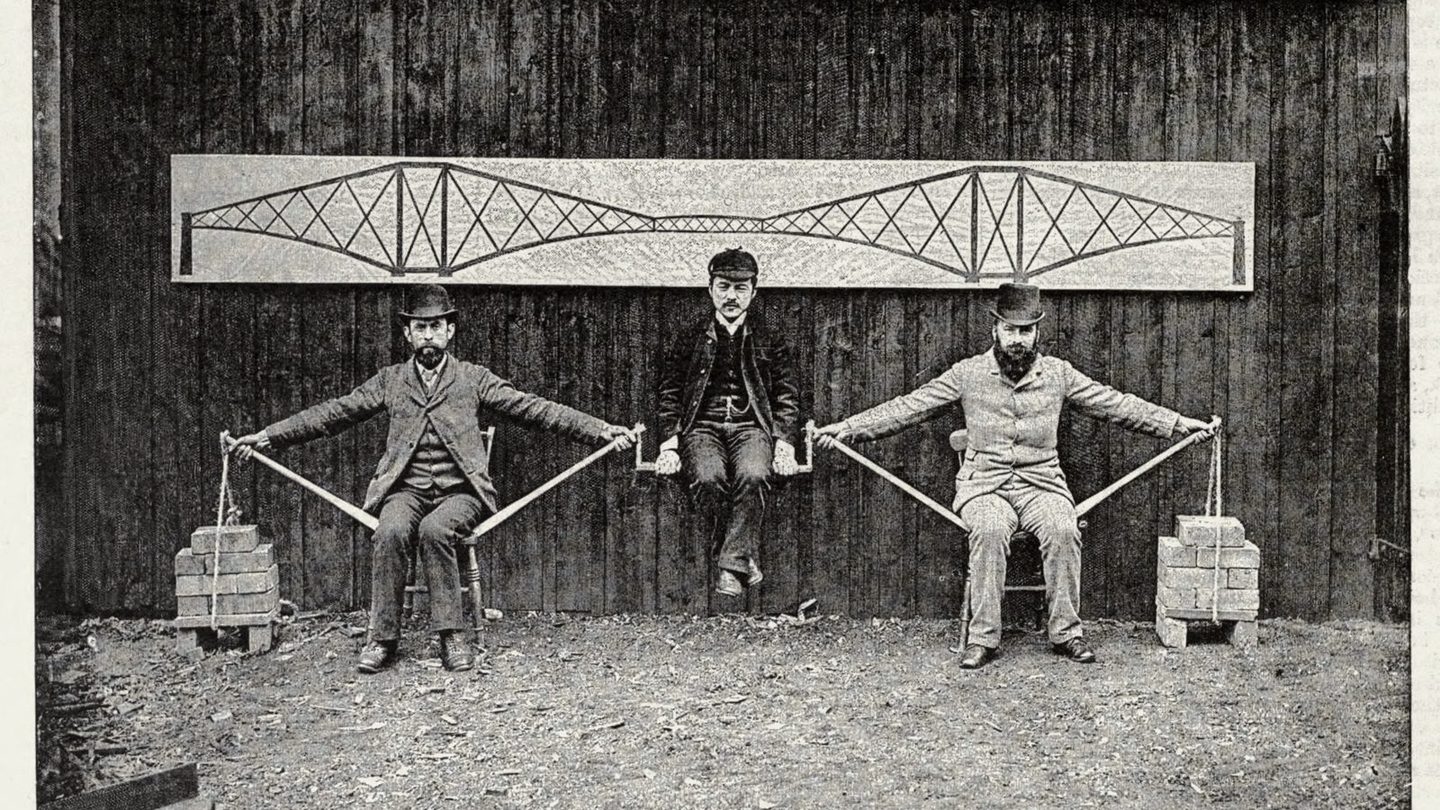
By 1887 Fowler and Baker had already broken ground on the Forth Bridge, but a cantilever this size had never been attempted, and Baker still needed to make the invisible physics behind it obvious to a nontechnical audience. For a lecture at the Royal Institution in London that year, he built a physical demonstration of the design rather than trying to explain the physics with diagrams alone. Fowler and Baker sat on chairs facing each other, arms outstretched and each supported underneath by a wooden pole taking the compression, while piles of bricks stacked at the outer ends anchored the whole arrangement to the ground the way an anchor arm ties into its abutment. The full apparatus, as documented by Princeton's structural engineering teaching archive, used three men, two chairs, two piles of bricks, and four broomsticks. Sitting suspended between the two men, supported entirely by their linked arms, was Kaichi Watanabe, a Japanese civil engineer who had graduated from the University of Glasgow the year before and was working on Baker's own staff, according to the University of Glasgow's account of his role. Watanabe's weight, pressing down through Fowler's and Baker's arms into the bricks, stood in for the load a train would eventually put through the bridge's steelwork and into its own foundations.
Turning a structural relationship nobody in the room could see into something everyone in the room could watch hold together wasn't a new engineering habit in 1887, only a new application of one. Centuries earlier and on a different continent, Inca administrators had solved their own problem of making an abstract system physically legible by encoding an empire's numerical records into knotted cords rather than any written script, a different material and a different kind of information, but the same underlying move: if you can't explain the system, build something people can watch, or touch, work instead.
The design got chosen because a different bridge fell down
The Forth Bridge is a cantilever today because the original plan for crossing the same river depended on an engineer whose bridge over a different river had just collapsed. The 1871 proposal for the Forth was a suspension design by Thomas Bouch, who was already at work nearby on the Tay Bridge. On the night of 28 December 1879, during a violent storm, the Tay Bridge collapsed as a train was crossing it, killing everyone aboard. The public inquiry into the disaster, chaired by Henry Cadogan Rothery, found the bridge "badly designed, badly constructed and badly maintained" and held Bouch "mainly to blame", specifically for failing to account for wind loading. Bouch had designed the Tay Bridge, and his own 1871 Forth proposal, around a wind-loading allowance of just 10 pounds per square foot, a figure he had taken on the advice of the Astronomer Royal; in response to the inquiry's findings, the Board of Trade required every future British bridge to be designed for 56 pounds per square foot instead, more than five times Bouch's original assumption.
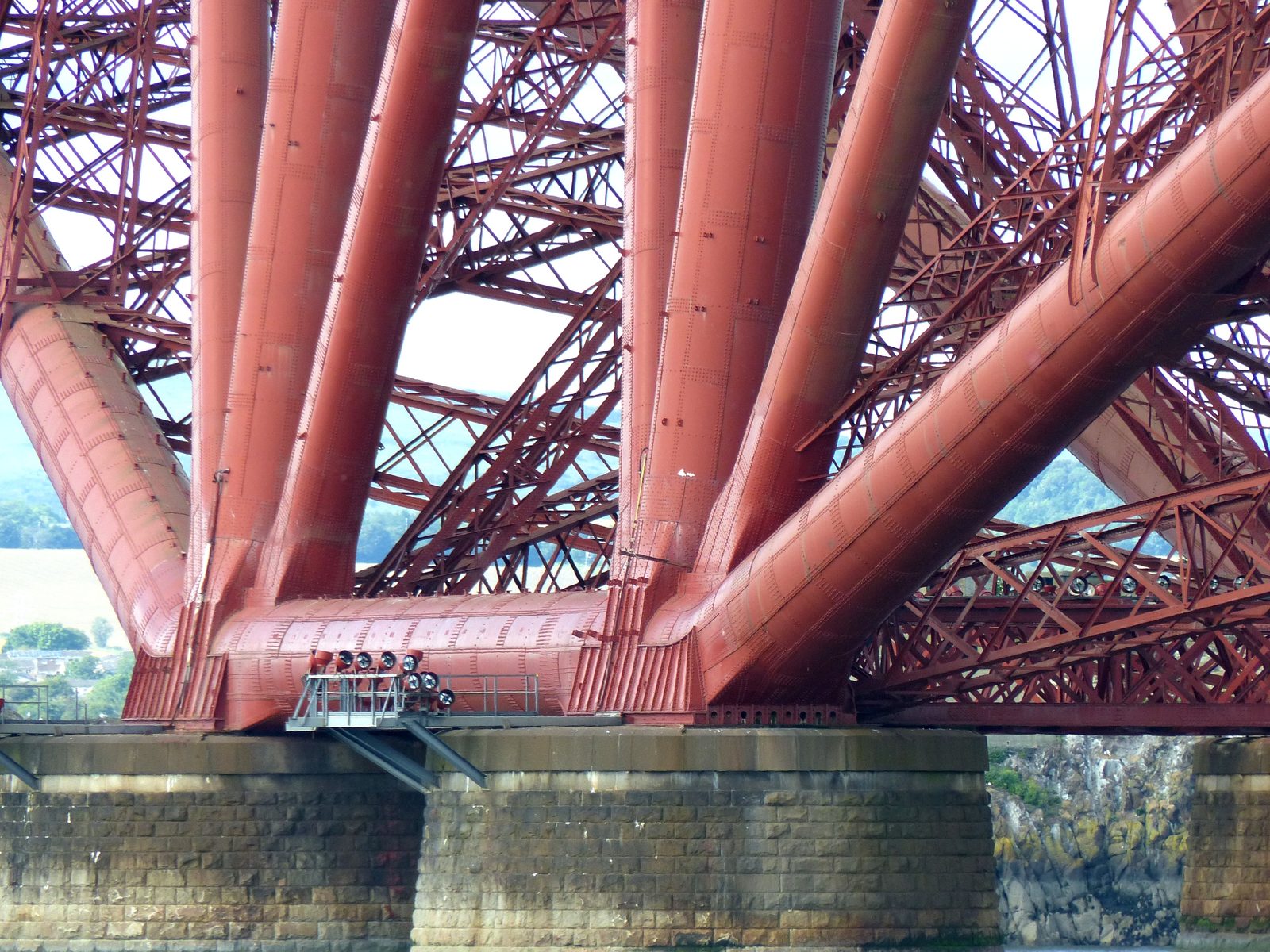
Confidence in Bouch's Forth design, and in Bouch himself, evaporated. His proposal was formally abandoned on 13 January 1881, and the project's consulting engineers invited new designs from Fowler, W. H. Barlow, and T. E. Harrison. Fowler and Baker's cantilever answer, sized to satisfy the new wind-loading rule with a wide safety margin, went into construction in 1882 and opened on 4 March 1890. The finished structure ran 2,467 meters (8,094 feet) end to end, its two main spans measuring roughly 521 meters (1,710 feet) each, built from two 207-meter cantilever arms with a 107-meter suspended truss dropped between them, and used about 6.5 million rivets to hold together roughly 50,500 long tons of steelwork. At its construction peak the project employed around 4,600 workers. Contemporary engineer Wilhelm Westhofen recorded 57 deaths in 1890; a research project by local historians that ran through 2009 traced named records for 73 confirmed deaths instead, a toll that breaks down as 38 falls, 9 workers crushed, 9 drowned, 8 struck by falling objects, 3 killed in a hut fire, and 1 from caisson disease, with 5 causes unrecorded.

One bridge still holds the record; a different one carries more traffic
The Forth Bridge held the longest-cantilever-span record for 27 years. Quebec Bridge, under construction across the St. Lawrence River in Canada, eventually took it, the same project whose 1907 collapse, a buckled compression chord that dropped 75 of 86 ironworkers into the river in about 15 seconds, is covered in full elsewhere on this site. A second failure during reconstruction killed 13 more workers in 1916, when a casting gave way while a rebuilt center span was being hoisted into place, bringing the total lives lost across both collapses to 88. A replacement span succeeded almost exactly a year later: Quebec Bridge's 549-meter (1,801-foot) span was structurally completed in September 1917, opened to rail traffic that December, and formally inaugurated by the Prince of Wales in 1919. Its two 177-meter cantilever arms, carrying a 195-meter central span between them, still hold the world cantilever-span record today, more than a century later.
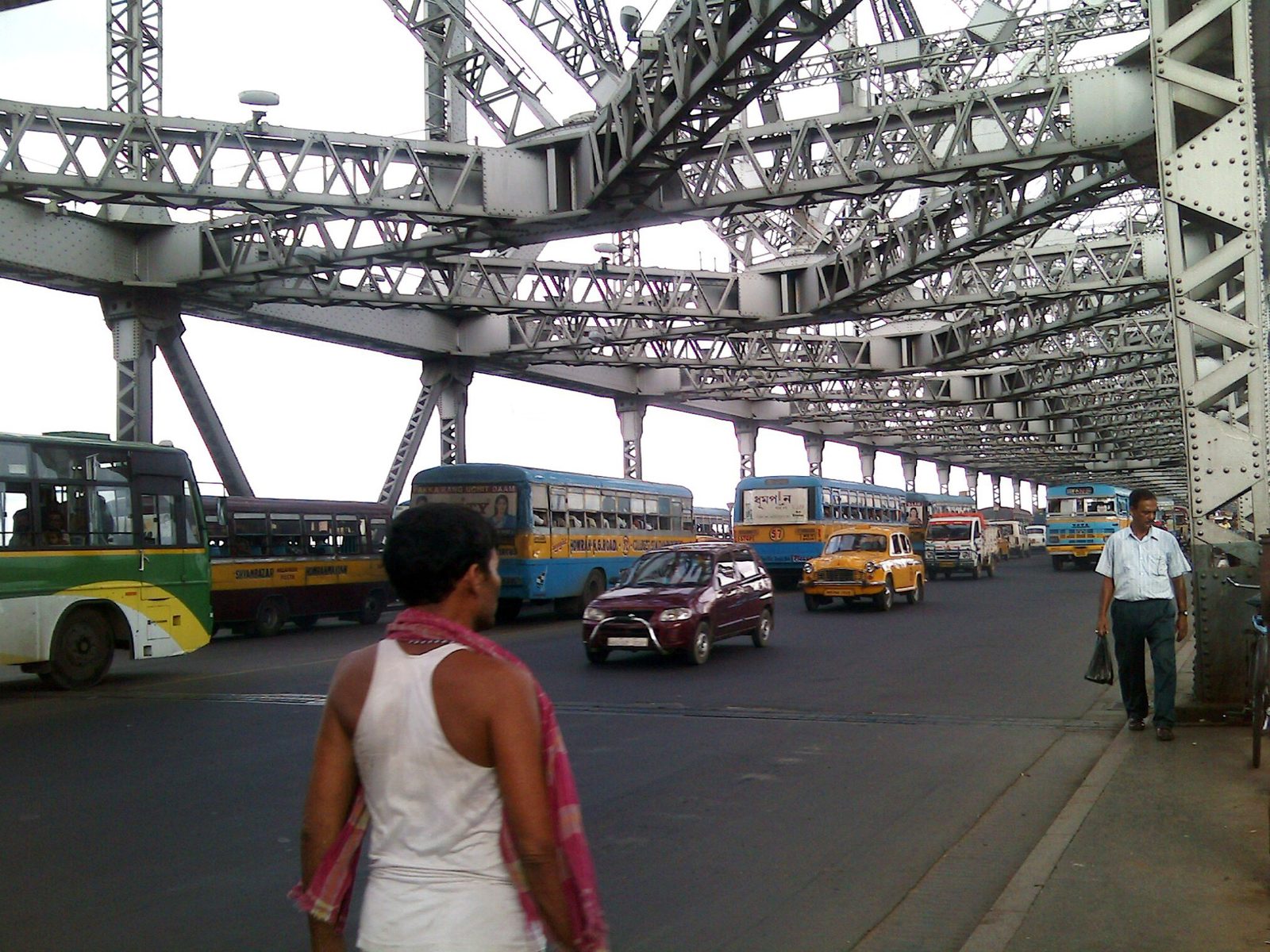
India's Howrah Bridge, over the Hooghly River in Kolkata, holds a different record: it's the busiest cantilever bridge on Earth, carrying roughly 100,000 vehicles and more than 150,000 pedestrians every day, according to Wikipedia's sourced account of its traffic volume, despite ranking only sixth-longest among the world's cantilever spans. Construction ran from 1936 to 1943, delayed partway through when the Second World War diverted the steel England had been supplying; of the roughly 26,500 tons of steel the bridge eventually consumed, 23,000 tons came from Tata Steel as a high-tensile alloy called Tiscrom, with barely 3,000 tons still arriving from Britain. The finished structure has no nuts or bolts anywhere in it; every connection in the entire bridge is riveted. The two halves of its central suspended span, each weighing 2,000 tons, were built separately and then joined in place using sixteen hydraulic jacks rated at 800 tons apiece. The bridge opened to traffic in 1943 with no formal ceremony, out of wartime fear that a public opening would draw an attack, and was renamed Rabindra Setu in 1965 after the poet Rabindranath Tagore, though almost everyone still calls it by its original name.